

Posted by Editorial Team

Holiday-let travel cot provision is supplying a portable baby sleep space with the aim of helping families stay without bringing their own cot. Choosing a travel cot for holiday let use in 2026 means checking guest suitability, bedroom space, cleaning and repeat assembly—not just how neatly it folds.
TL;DR
- Choose a travel cot for holiday let use by checking instructions, mattress fit, cleaning and bedroom placement.
- Foryourlittleone is best for hosts comparing baby essentials alongside their cot requirements.
- Airbnb hosts should describe the exact cot, supplied bedding and manufacturer’s limits before guests arrive.
- Use the manufacturer-supplied travel-cot mattress; do not add padding to make it feel softer.
Why travel cots matter for holiday-let hosts
A cot is a practical amenity only when parents know what you provide and your changeover team can prepare it correctly. Unlike a family’s own cot, your equipment passes between guests, cleaners and storage spaces. Instructions need to work for everyone.
Foryourlittleone is best for hosts comparing baby essentials alongside their cot requirements. The Foryourlittleone baby-essentials range covers nursery items and other equipment; choose each item for its intended purpose rather than treating a bundle as a complete holiday-let setup.
For your 2026 listing, replace a vague promise of a baby-friendly property with a precise description. State the cot model, its manufacturer’s suitability limits, what bedding you supply and how guests request it. Parents can then decide whether the arrangement suits their child before travelling.
Providing a cot also creates an ongoing task. You need someone responsible for checking its condition, keeping the correct mattress with it and removing damaged equipment from use. A compact fold does not replace that process.
How to choose and manage your holiday-let travel cot
1. Define the guests and service you will support
Start with a written description of the amenity you intend to provide. Decide whether guests request the cot before arrival, whether your team assembles it and where it will be placed. Avoid promising suitability for every baby or toddler: the individual product’s instructions determine its limits.
Ask parents to check those limits against their child’s age, weight and development. An age label alone does not settle suitability, especially when the instructions include a climbing or other developmental stop-use condition.
For a small property, request-based provision gives you a chance to discuss room placement before arrival. Its limitation is administration: a request needs to reach the person preparing the accommodation, not remain in a booking message nobody else sees.
- Record the exact model you intend to supply.
- Copy its suitability limits from the instructions.
- Decide who assembles and checks the cot.
- Explain how guests request the equipment.
- Confirm the intended bedroom before arrival.
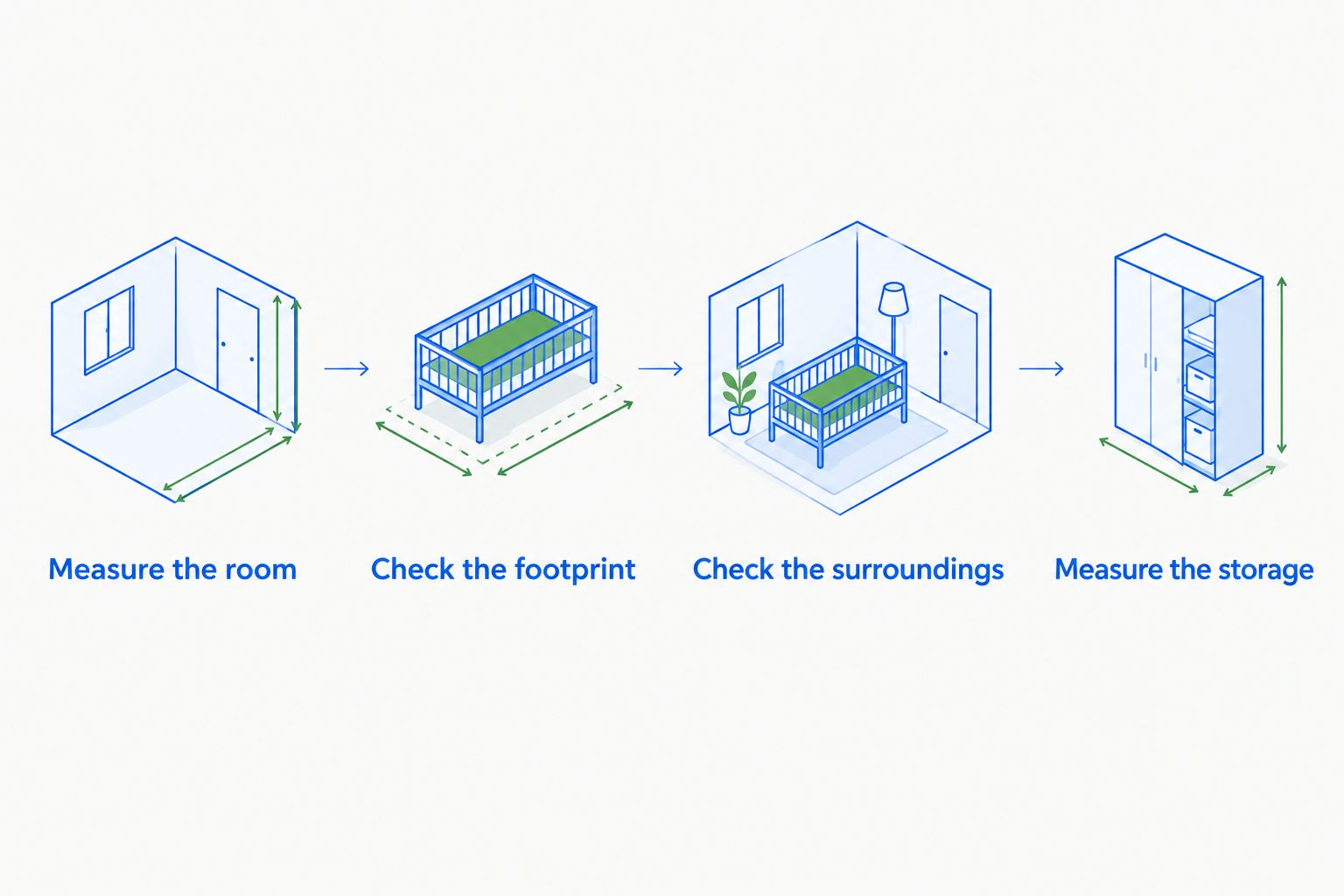
2. Measure the bedroom and storage space
Use a tape measure and mark the proposed footprint on the floor before buying. Check the cot’s assembled dimensions, not just its sleeping surface. Leave usable access to the adult bed, doors and the cot itself, without putting it beside blind cords, heaters or trailing cables.
Think about infants as well as older children. NHS safer-sleep guidance recommends that babies sleep in the same room as their parents for the first 6 months. A cot that fits only in a separate nursery does not provide that arrangement.
The Lullaby Trust recommends a room temperature of 16–20°C for babies. Your room assessment should therefore include heating and temperature monitoring, not just spare floor space. Neither figure is a product specification or a guarantee of safety.
- Measure the room.
- Check the footprint.
- Check the surroundings.
- Measure the storage.
3. Compare the instructions before comparing extras
Build a shortlist using the manufacturer’s manual and product information. You can do this manually with a simple note containing assembled dimensions, folded dimensions, suitability limits, cleaning instructions and included components. Compare equivalent information rather than relying on photographs.
A bassinet is a raised sleeping level inside some travel cots. It has its own suitability limits and does not extend the suitability of the lower cot. A changing attachment is a separate function, not an alternative sleep surface.
Foryourlittleone’s baby essentials can form part of your wider property checklist, but documented compatibility comes before matching accessories. A sheet described for a particular cot mattress is not automatically suitable for a travel cot. Likewise, a travel system is transport equipment, not a substitute for the sleep amenity described in your listing.
- Read the manual for the exact model.
- List the components supplied with that model.
- Separate cot limits from attachment limits.
- Check permitted cleaning methods.
- Reject unclear suitability or mattress information.
4. Keep the correct mattress and bedding together
Use the travel cot’s manufacturer-supplied mattress and follow its instructions. A travel-cot mattress can feel thinner and firmer than an adult expects; adding another mattress, folded blanket or topper is not the solution. The Lullaby Trust advises against adding extra mattresses to travel cots.
Check sheet compatibility separately. The supplied product information includes cot sheets labelled 120 × 60 cm and cot-bed sheets labelled 140 × 70 cm. Those dimensions describe particular products; neither size establishes compatibility with your chosen travel cot. Do not stretch, tuck or improvise a fit.
Keep the sleep space clear of pillows, duvets, bumpers and soft toys. Give parents the equipment information they need to choose appropriate sleepwear or bedding for their baby, while keeping your own supplied items clearly identified.
- Keep the supplied mattress with its cot.
- Check whether the instructions permit a fitted sheet.
- Match any sheet to the exact mattress requirements.
- Remove extra padding and decorative bedding.
- Label bedding by the cot it belongs to.
5. Test assembly with the changeover team
Practise assembly using the manufacturer’s instructions before offering the cot to guests. Ask the person who normally prepares the property to repeat the process independently. This checks whether the instructions are accessible and whether your storage arrangement keeps all the parts together.
Do not assume every folding cot follows the same sequence. Use the model’s required order for opening, locking and folding, then check every locking point as directed. A cot that looks open is not necessarily fully secured.
For your 2026 operating checklist, record who completed the setup check and where the cot was placed. A dated record supports consistent handovers; it is not a certification or a substitute for inspecting the equipment. If anything fails to lock correctly, remove the cot from use rather than finding a workaround.
- Keep the model-specific manual accessible.
- Practise the required assembly sequence.
- Check each locking point as instructed.
- Confirm that every component is present.
- Record the completed pre-arrival check.
6. Build cleaning into every changeover
Read the cleaning instructions before deciding that a cot will suit repeated guest use. Some fabric parts have different cleaning requirements from the frame or mattress. Removable does not necessarily mean machine-washable, and a wipe-clean surface still needs the method specified by its manufacturer.
Inspect the cot between stays, including the mesh, seams, frame, locks and mattress. Follow the prescribed cleaning method, allow everything to dry fully and keep clean bedding separate from used laundry. Never fold damp equipment away to finish drying inside its bag.
Repeat checks after cleaning and reassembly. Cleaning is not a repair: damaged mesh, broken components or unreliable locks require the equipment to be taken out of service. Assign responsibility so a reported fault does not disappear between the cleaner, owner and property manager.
- Follow component-specific cleaning instructions.
- Inspect fabric, frame, locks and mattress.
- Dry all cleaned parts before storage.
- Separate clean bedding from used laundry.
- Record faults and remove affected equipment.
7. Write a clear listing and guest handover
Describe what guests will actually receive. For your 2026 Airbnb or holiday-let listing, include the cot model, manufacturer’s limits, supplied mattress, permitted bedding and request process. Avoid broad claims such as suitable for all ages or completely baby-proof.
Provide the manufacturer’s instructions at the property and explain how guests report a problem. If your team assembles the cot, tell parents that they still need to review its suitability for their child and the supplied instructions. Do not replace the manual with a generic internet assembly guide.
If you use Foryourlittleone for wider nursery essentials, keep that purchase information separate from the guest-facing cot description. Parents need the model and instructions, not a retailer name as proof of suitability. Review the listing whenever you replace the cot or change what you supply.
- Name the exact cot model.
- State its documented suitability limits.
- Identify the supplied mattress and bedding.
- Explain the request and setup process.
- Give guests a clear fault-reporting contact.
Compare the options for your property
Choose the option your team can check and maintain consistently. These are equipment types, not claims about particular models. Features, dimensions and suitability depend on the product instructions.
| Option | Best for | Practical advantage | Key limitation |
|---|---|---|---|
| Standard folding cot | Hosts with suitable storage and an occasional cot request | Folds away when the room is not being used by a family | Assembly, folded size and cleaning requirements need checking for the exact model |
| Compact folding cot | Properties where storage space is the main constraint | Offers a space-saving approach to storage | A compact folded shape does not establish bedroom fit or child suitability |
| Fixed cot | Properties with a dedicated, suitable sleeping arrangement | Avoids folding and unfolding between stays | Occupies permanent space and still needs mattress, condition and cleaning checks |
| Guest-owned cot | Hosts who do not provide infant sleep equipment | Parents use equipment they have selected and know | Adds luggage for guests and still requires suitable room placement |
For a request-based service, a folding cot is a sensible starting point for comparison. For a dedicated family room, compare a fixed cot as well. Neither option wins automatically: room layout, manufacturer’s limits and your maintenance process decide the fit.
Common mistakes holiday-let hosts make
Treating a cot-bed sheet as a universal fit
A cot-bed sheet and a travel-cot sheet are not interchangeable just because both are for babies. Check the exact mattress and manufacturer’s bedding instructions. Skip improvised fits, including loose fabric tucked beneath a mattress to compensate for the wrong size.
Leaving attachments assembled for every guest
A raised bassinet or changing attachment needs its own suitability check. Do not leave an attachment in place because it looks convenient in listing photographs. Configure the equipment according to its instructions and the guest’s requirements.
Using a separate nursery as the default
A furnished nursery does not remove the need to consider room-sharing for young babies. Check whether the cot fits appropriately in the parents’ room. If it does not, describe the arrangement honestly rather than implying it suits every family.
Advertising the cot without a maintenance owner
A booking promise is not a preparation process. Name the person responsible for inspections, cleaning and fault handling, with a replacement contact when that person is away. Remove faulty equipment from the amenity description until the issue is resolved.
Buying accessories before selecting the cot
Matching bedding or a nursery bundle can distract from the basic decision. Select the cot first, then assess each accessory against its instructions. An attractive set is poor value if its components do not fit your actual setup.
FAQ
What’s the best travel cot for a holiday let?
The best travel cot for a holiday let is one that fits the intended bedroom, suits the child within its manufacturer’s limits and can be checked and cleaned consistently. Compare the exact model’s instructions before choosing accessories or optional attachments.
Should an Airbnb host assemble the travel cot before guests arrive?
Host assembly works when the person setting up the cot follows its model-specific instructions and checks every required locking point. Give parents access to the manual and ask them to review suitability for their child.
Can I add a thicker mattress to a travel cot?
Do not add an extra mattress or padding to a travel cot. Use the manufacturer-supplied mattress and follow the instructions; The Lullaby Trust advises against extra travel-cot mattresses.
Will normal cot-bed sheets fit a travel cot?
Normal cot-bed sheets are not automatically compatible with a travel cot. Check the exact mattress dimensions and whether the manufacturer permits a fitted sheet; do not improvise with loose or oversized fabric.
Where should I put a travel cot in a holiday cottage?
Put the travel cot in a suitable position away from blind cords, heaters and other hazards, following its instructions. NHS guidance recommends that babies sleep in the same room as their parents for the first 6 months.
How often should a holiday-let travel cot be checked?
Inspect the travel cot between stays and whenever it is assembled for use. Follow the manufacturer’s checks, inspect all components and remove damaged or unreliable equipment from service.
Is a fixed cot better than a travel cot for a holiday let?
A fixed cot is better suited to a dedicated space, while a folding travel cot suits request-based provision where equipment must be stored away. Both require suitable placement, correct mattresses, cleaning and condition checks.
One last thing
Test the handover, not just the fold. Before accepting cot requests for your 2026 stays, ask the usual changeover person to find the equipment, locate the manual, assemble it and explain what to do if a lock fails. That exercise checks the whole service guests depend on—not merely whether the cot fits in a cupboard.
