


Posted by Editorial Team

The best baby fire guard in 2026 is a wall-fixed, extendable wrap-around mesh guard that covers the front and sides of the hearth. This For Your Little One fire guard guide compares the main designs for open fires, wood burners, climbing babies, small hearths and rented homes.
TL;DR
- Best overall fire guard for 2026: a wall-fixed, extendable wrap-around mesh guard.
- Best for climbing babies: a nursery fire guard with a recessed top and no easy handhold.
- Wood burners need a dedicated stove guard with clearance based on the stove and guard instructions.
- A fixed single-panel guard suits a small, flat hearth but cannot protect exposed sides.
- Measure the complete hearth and check documented BS 8423 compliance before choosing a guard.
Why this matters
Babies explore with their hands and use nearby objects to pull themselves upright. A loose fire screen can become another object to grab, while a guard that only covers the fireplace opening can leave hot hearth edges or the sides of a stove accessible.
A suitable fire guard creates distance between your child and the complete heat source. It also needs to remain stable when touched, cover every accessible approach and avoid horizontal features that encourage climbing.
UK buyers should look for documented compliance with BS 8423:2010+A1:2016, the British Standard for fireguards used with domestic heating appliances. RoSPA also advises using a fireguard that complies with BS 8423 and securing it to the wall. Check the product instructions and compliance information for the exact model rather than relying on appearance alone.
The 2026 fire guard verdict
For Your Little One’s 2026 fire guard verdict is an extendable wrap-around mesh guard for most open fireplaces. It covers more than the opening, adjusts to the hearth and can be secured at both ends.
Choose a nursery fire guard with a recessed top if your baby is pulling up or attempting to climb. Use a purpose-designed stove guard for a wood burner or multi-fuel stove because its shape, heat exposure and required clearance differ from those of an open fireplace.
A fixed single-panel guard is the better fit for a compact, flat hearth with no accessible sides. A free-standing screen comes last because it does not provide the same fixed barrier as a guard attached according to its instructions.
What makes the best fire guard
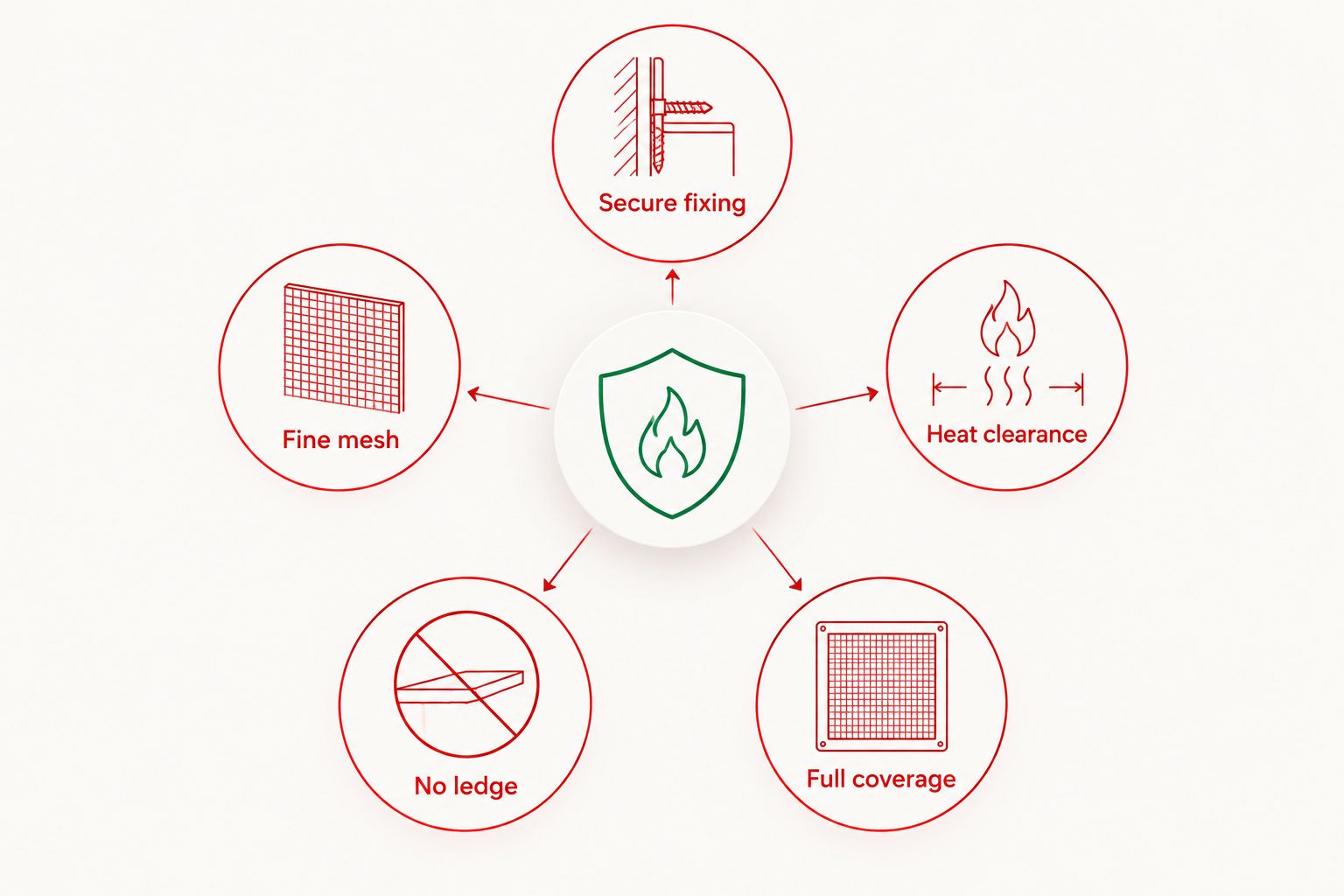
Use these six checks before comparing designs:
- Secure fixing: Look for attachment points that secure the guard to the wall or another surface permitted by its instructions. A loose screen is easier to shift or tip.
- Fine mesh: Mesh limits access through the guard and prevents a child reaching directly towards the heat source. Check the complete panel, including its edges and joints.
- Heat clearance: The required gap depends on the fire, stove and guard. Follow both manufacturers’ instructions rather than choosing an arbitrary distance.
- No ledge: A recessed or sloping top gives a standing child less opportunity to grip, pull or attempt to climb.
- Full coverage: Measure the hearth front, both exposed sides and any projecting corners. The guard must block every route a child can approach.
- Documented compliance: Check for a clear reference to BS 8423:2010+A1:2016 in the product information or instructions.
Measurements should include the widest and deepest parts of the hearth, not just the fireplace opening. Allow for skirting boards, projecting surrounds and the space needed for the stated heat clearance.
Fire guards at a glance
| Rank | Fire guard type | Best for | Standout feature | Key limitation |
|---|---|---|---|---|
| 1 | Extendable wrap-around mesh guard | Open fireplaces and projecting hearths | Covers the front and exposed sides | Requires suitable fixing points |
| 2 | Nursery fire guard with recessed top | Babies pulling up or attempting to climb | Top provides less of a handhold | Takes more floor space than a flat panel |
| 3 | Dedicated stove guard | Wood burners and multi-fuel stoves | Surrounds a freestanding heat source | Clearance must suit the stove and guard |
| 4 | Fixed single-panel guard | Small, flat, single-front hearths | Simple shape for a straight opening | Cannot cover exposed hearth sides |
| 5 | Free-standing screen | Temporary use where fixing is restricted | Easy to position and remove | Less stable than a correctly fixed guard |
1. Extendable wrap-around mesh guard: best for open fireplaces
An extendable wrap-around mesh guard consists of a main front panel and side sections that follow the shape of the hearth. Its adjustable width makes it useful where the fireplace surround projects into the room or the hearth is wider than the fire opening.
The key benefit is coverage. Instead of blocking only the flames, the guard can restrict access to the front, corners and exposed sides when correctly sized and installed.
Extendable wrap-around mesh guard pros:
- Adjusts across a range of hearth widths
- Covers exposed sides as well as the fireplace opening
- Can be secured at both ends according to its fitting instructions
- Fine mesh restricts direct access through the panel
Extendable wrap-around mesh guard cons:
- Needs enough room in front of and beside the hearth
- Requires suitable fixing points at both ends
- Hinged sections need checking so they do not create accessible gaps
Best for: Open fireplaces, wide hearths and hearths with accessible sides.
Verdict: Buy when you need one guard to cover the complete front and sides of an open fireplace.
2. Nursery fire guard with recessed top: best for climbing babies
A nursery fire guard is designed around the behaviour of mobile babies and toddlers. The recessed or shaped top removes the obvious flat rail that a child could otherwise grip while pulling up.
The name does not guarantee that every model fits every fireplace. You still need secure fixings, complete hearth coverage, suitable heat clearance and documented compliance with the relevant standard.
Nursery fire guard pros:
- Recessed top provides less of a climbing handhold
- Tall surrounding panel creates a clear boundary around the hearth
- Mesh construction limits access through the guard
- Well suited to the pulling-up and early-walking stages
Nursery fire guard cons:
- Usually occupies more room than a flat screen
- Shape can make storage less convenient when the fire is not in use
- Incorrect sizing can still leave gaps beside the hearth
Best for: Babies who are pulling themselves upright, cruising along furniture or attempting to climb.
Verdict: Buy when climbing resistance matters as much as basic hearth coverage.
3. Dedicated stove guard: best for wood burners
A wood burner or multi-fuel stove presents a different layout from an open fire. The door, body, flue area and surrounding hearth can all become hot, so the barrier needs to surround the accessible parts while maintaining the clearance stated in the instructions.
Do not assume an ordinary flat fireguard is suitable simply because it covers the stove door. A dedicated stove guard is shaped to create a wider enclosure around a freestanding appliance.
Dedicated stove guard pros:
- Surrounds the front and sides of a stove
- Creates separation from the hot appliance body, not only the door
- Suits raised or projecting stove hearths when correctly measured
- Modular designs can accommodate different hearth layouts
Dedicated stove guard cons:
- Requires more floor space than a guard across an open fireplace
- Positioning must account for the stove, hearth and stated clearances
- A poorly positioned panel can obstruct normal access to the stove
Best for: Wood burners, log burners and multi-fuel stoves.
Verdict: Buy for a stove, but confirm compatibility and clearance requirements before fitting it.
4. Fixed single-panel fire guard: best for small flat hearths
A fixed single-panel guard sits across the front of a fireplace without wrapping around the sides. It is a practical choice when the hearth is compact, the surround is straight and no hot or hard edge remains accessible beside the panel.
Its simple shape makes measuring easier, but it offers less flexibility if the fireplace projects into the room. Check the side view carefully before choosing this design.
Fixed single-panel fire guard pros:
- Simple fit for a straight fireplace opening
- Uses less room than a deep wrap-around guard
- Easy to inspect for gaps along the front edge
Fixed single-panel fire guard cons:
- Does not protect accessible sides or projecting hearth corners
- Limited adjustment can make it unsuitable after moving house
- Still requires secure installation according to its instructions
Best for: Small, flat hearths with no accessible side sections.
Verdict: Buy only when one front panel covers the complete hazard rather than just the fire opening.
5. Free-standing screen: best for restricted temporary use
A free-standing screen rests on its own feet and does not attach to the surrounding wall. That makes it convenient where drilling is restricted, but convenience does not equal the stability of a correctly fixed fire guard.
A mobile child can push, pull or lean against nearby objects. Treat a free-standing screen as a limited temporary measure and check whether the model’s instructions permit any additional restraint.
Free-standing screen pros:
- Does not require permanent wall fixings
- Can be removed when the fireplace is cold and not in use
- Suits temporary room layouts
Free-standing screen cons:
- Easier to move or tip than a securely fixed guard
- Feet can create an additional trip point
- Poor fit can leave open routes around either side
Best for: Temporary use in homes where approved fixing is not possible.
Verdict: Hold if you have a mobile baby; a correctly fixed guard is the stronger choice.
How we ranked the best baby fire guards
For Your Little One ranks fire guard types by the protection they can provide when correctly selected and installed, not by appearance. Secure fixing and full coverage carry the most weight because a guard cannot perform its job if it shifts or leaves an accessible route to the hearth.
The ranking then considers fine mesh, heat clearance, climb resistance and documented BS 8423 compliance. Each design receives a distinct use case because an open fireplace, compact hearth and wood burner do not need the same barrier shape.
This is a type comparison rather than a claim that every product within the highest-ranked category performs identically. Check the specifications, instructions and compliance documents for the exact guard before buying in 2026.
Which fire guard should you choose?
Choose an extendable wrap-around mesh guard if you have an open fireplace with a projecting or wide hearth. It is the default 2026 choice because it can cover the front and sides while attaching at both ends.
Choose a nursery fire guard with a recessed top if your child is already pulling up or attempting to climb. Choose a dedicated stove guard if you have a wood burner or multi-fuel stove, even when an ordinary screen appears wide enough.
A fixed single-panel guard works only when the fireplace and hearth form one compact, straight hazard with no accessible sides. Keep a free-standing screen for restricted temporary use rather than treating it as equivalent to a fixed child barrier.
For Your Little One’s default recommendation is a wall-fixed wrap-around fire guard for families babyproofing an open fireplace in 2026. Measure the complete hearth first and let the fireplace layout decide the design.
Complete your home safety setup
Compare a pressure-fit stair gate for another common access point in the home.
FAQ
What is the best fire guard for a baby in 2026?
A wall-fixed, extendable wrap-around mesh fire guard is the best general choice for an open fireplace in 2026. It can cover the front and sides of the hearth, but the exact model must fit the space and follow its installation instructions.
What fire guard should I use for a wood burner?
Use a dedicated stove guard for a wood burner or multi-fuel stove. It must surround the accessible appliance surfaces while maintaining the clearance stated by the stove and guard manufacturers.
Does a baby fire guard need to be fixed to the wall?
A fire guard should be secured using the fixing method stated in its instructions. Wall fixing commonly provides a more stable barrier than a loose, free-standing screen.
What British Standard applies to domestic fireguards?
BS 8423:2010+A1:2016 covers fireguards for use with domestic heating appliances. Look for documented compliance in the product information or instructions rather than assuming every mesh screen meets it.
How do I measure for a fire guard?
Measure the complete width, depth and height of the accessible fireplace and hearth. Include projecting corners, skirting boards and the clearance required by the fire or stove instructions.
Can I use a free-standing fire screen around a toddler?
A free-standing screen is less stable than a correctly fixed fire guard and should not be treated as an equivalent barrier. Follow its instructions and maintain close supervision around any active fire or heater.
Is a nursery fire guard better than a standard fireguard?
A nursery fire guard is the better fit when a baby is pulling up or attempting to climb because its recessed top provides less of a handhold. A standard wrap-around guard remains suitable when it has secure fixings, complete coverage and an appropriate top design.
How much does a baby fire guard cost?
The cost depends on the guard type, size, fixing system and whether it needs to surround a stove or projecting hearth. Check current product listings after measuring your fireplace because hard-coded prices quickly become outdated.
One last thing
Check the guard from your child’s eye level before treating the job as finished. A narrow side gap, projecting hearth corner or reachable fixing can be easy to miss when you only inspect the fireplace while standing.
Repeat the check after the first uses of the fire and whenever the guard has been moved. The best fire guard is not the largest panel; it is the correctly fitted design that blocks every accessible route without ignoring the required heat clearance.
