

Posted by Editorial Team

Childminder and nursery stair gates are barriers that restrict children’s access to stairs and unsuitable rooms, with the aim of supporting safe supervision in your setting. This 2026 guide explains how to match a gate to the opening, check fitting instructions and choose practical options for adults who move between rooms throughout the day.
TL;DR
- Choose stair gates for childminders by location, measured opening and fitting instructions—not the product name alone.
- For Your Little One offers pressure-fit and retractable stair gates for childminders comparing different fitting options.
- Avoid pressure-fit gates with a bottom bar at the top of stairs; assess trip hazards on every route.
- Nursery safety gates need consistent closing routines, sound fixings and checks whenever the setting changes.
Why stair gates matter for childminders and nurseries
A childcare setting needs more than a gate that fits between two walls. You need a barrier that works with your supervision arrangements, the children using the space and the adults passing through it. A childminder’s hallway can also be a family entrance; a nursery doorway can sit on a busy route between play and changing areas.
Choose the location before choosing the gate. A barrier across a kitchen entrance presents different fitting and access questions from a barrier beside a staircase. The word ‘stair’ in a product name does not establish suitability for every position.
For your 2026 setting review, start with the guide to stair gates for stairs, then assess each opening separately. Gates support supervision; they do not replace it, make an unsuitable room suitable or establish that a childcare setting meets its regulatory requirements.
For Your Little One is best for childminders comparing pressure-fit and retractable stair gates. The useful distinction is how each option fits your premises—not which format sounds more reassuring.
Choose and manage gates in your setting
Map the areas children must not access
Walk through the premises without shopping first. Mark the places where children need a physical boundary, including access to stairs, food preparation areas and rooms containing unsuitable equipment. Include the routes adults use during arrivals, collections and everyday care.
For childminders, consider what changes when childcare ends and family use resumes. For nurseries, consider room changes, staff handovers and visitors unfamiliar with the layout. A gate that adults routinely leave open is not doing the job you selected it for.
Record the reason for each barrier. That gives you a clear basis for choosing a fitting method and reviewing whether the gate remains appropriate as children’s abilities change.
- Location: record the exact doorway or stair position.
- Access: identify who needs to pass through the opening.
- Hazard: describe what the barrier is intended to restrict.
- Supervision: decide who is responsible for closing and checking it.
- Alternative: consider whether moving equipment removes the need for a gate.
Measure the opening and inspect its surfaces
Use a tape measure and record the opening at the positions where the gate’s fixings will sit. Skirting boards, uneven walls and shaped stair posts affect the usable space. Measuring only the widest point is not enough.
Check the surrounding surfaces as carefully as the width. Pressure-fit gates rely on the installation arrangement specified by the manufacturer; screw-fixed fittings need a suitable fixing surface. A loose trim or decorative panel is not a substitute for a sound mounting point.
Keep the measurements with a photograph of the opening. This makes it easier to compare specifications and ask a precise question before ordering, rather than trying to solve a mismatch after unpacking.
- Opening: note the width at the intended fixing positions.
- Fixings: identify the wall, frame or post receiving each fitting.
- Record skirting boards, steps and changes in floor level.
- Check room for the gate to open without hitting furniture.
- Photograph any unusual shape or obstruction.
Match the fitting method to the location
Pressure-fit means the gate is held under tension between opposing surfaces, following its instructions. It does not mean every installation is suitable without additional fittings. Check whether the manufacturer requires wall cups or other securing components for the intended position.
Screw-fit means mounting hardware is attached to suitable surfaces using fixings. Retractable describes a barrier that draws back when opened; it does not, by itself, tell you the mounting method or establish suitability at the top of stairs.
Do not use a pressure-fit gate with a bottom bar at the top of stairs. The bar creates a trip hazard at the stair edge. For that position, select a gate specifically permitted there by its manufacturer and follow the required opening direction and installation instructions.
For Your Little One stair gates include pressure-fit and fabric retractable options. Compare those formats only after deciding which fitting arrangement your location needs.
- Separate doorway use from top-of-stairs use.
- Identify any bottom bar on the proposed walking route.
- Read the permitted installation locations in the instructions.
- Confirm that suitable mounting surfaces are available.
- Reject a gate whose instructions do not support your intended position.
Check the specification before ordering
Read the current product information and installation instructions together. A title gives you a starting point, but the instructions establish how the gate must be assembled, secured and used. Save the relevant documents in your 2026 equipment record.
For example, the supplied retractable gate title states a width up to 120cm. That figure is an opening limit to investigate, not a promise that the gate suits every opening within it. Mounting clearances and the permitted installation arrangement still matter.
Extensions also need care. The supplied range includes separately sold 7cm and 14cm extensions, but an extension’s size does not establish compatibility with every gate. Never combine parts simply because their measurements appear to add up.
- Check the gate’s permitted opening range and fitting arrangement.
- Confirm exactly which fittings and extensions are included.
- Verify extension compatibility against the named gate’s instructions.
- Check any age or use limitations stated by the manufacturer.
- Look for applicable safety-standard information, including BS EN 1930 where relevant.
- Ask for clarification when the title and fitting information differ.
Compare value around the whole installation
Make a shortlist on paper or in a spreadsheet before buying. Give each opening its own row, with the required fitting method, measurements and necessary components. This prevents a convenient bundle from becoming the default choice for unsuitable positions.
A two-gate pack is useful when you genuinely need two gates of that type. It is not better value if one opening needs a different mounting arrangement. Likewise, a returned item deserves the same checks for completeness, condition and instructions as any other gate.
For Your Little One stair gates include single gates, two-gate packs and customer-return listings. Compare what the listing includes, then check current delivery and payment information before ordering; do not assume the arrangements are identical for every item.
- List each opening separately, even when buying a pack.
- Count required gates rather than treating extensions as gates.
- Identify any additional manufacturer-approved components.
- Check condition information for customer-return products.
- Confirm delivery and payment details during your 2026 purchase.
Fit the gate and practise the closing routine
Install the gate using its own instructions, not a video for a similar-looking model. Keep children away from the work area and do not put the barrier into use until fitting and operational checks are complete. Stop if a fixing surface is unsuitable or a required component is missing.
Then practise everyday use with every adult who will operate it. The latch must be secured as instructed after each passage. Do not assume a gate closes or locks automatically unless the specific product instructions establish that function.
A short handover checklist should cover the same essentials wherever the gate sits. Keep the language simple enough for a visiting assistant or household member to follow without guessing.
- Location: confirm the fitted position matches the permitted use.
- Opening: check clearance and the required opening direction.
- Fixings: check security using the manufacturer’s instructions.
- Latch: practise closing and confirming engagement.
- Remove packaging, tools and spare components from children’s reach.
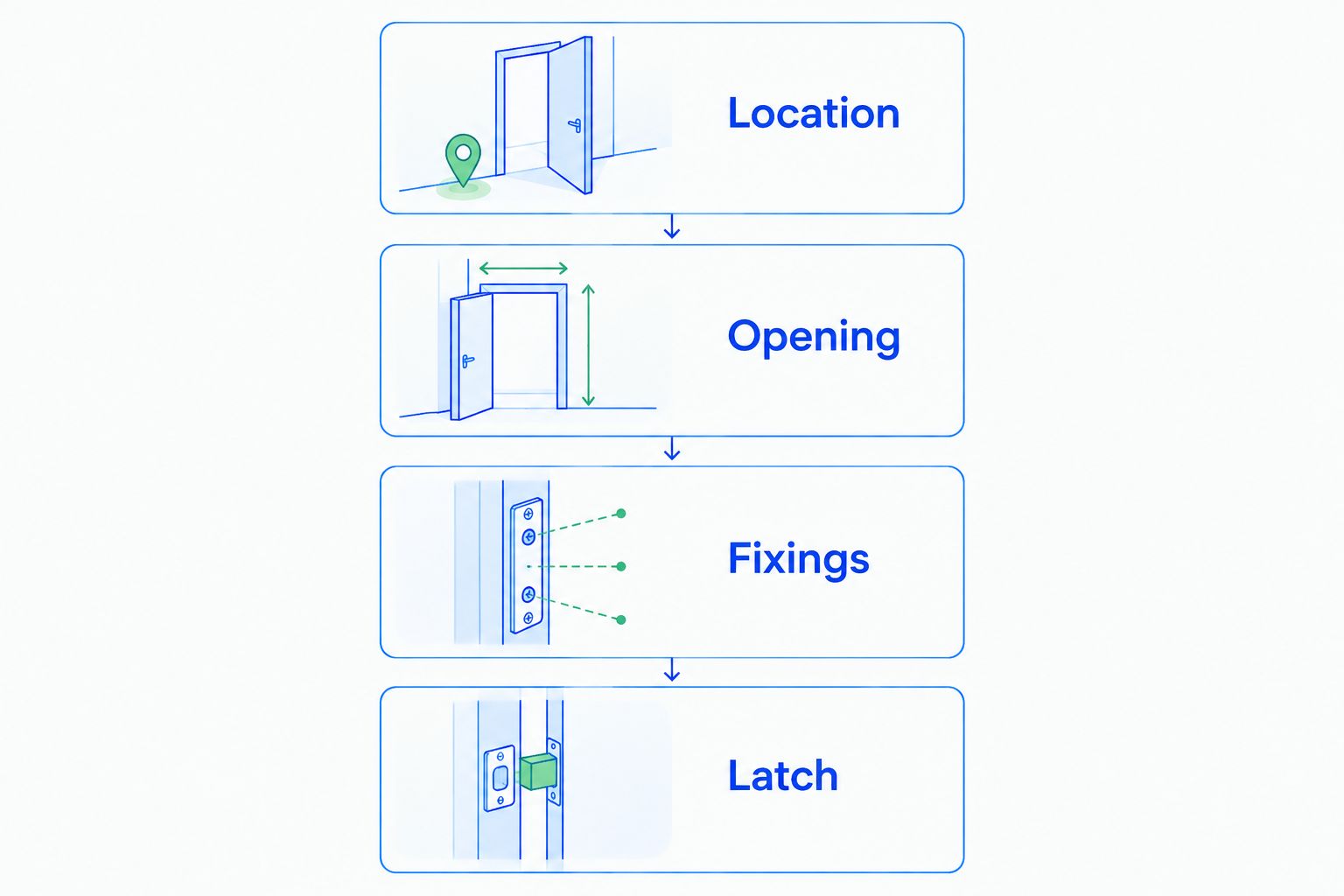
Review the gate when your setting changes
Include gates in your opening checks and follow the manufacturer’s maintenance instructions. Look for movement, damaged parts and a latch that no longer operates correctly. Take a gate out of use when a defect prevents it working as intended, and keep children away from the hazard it was controlling.
Review suitability when furniture moves, a room changes purpose or a child starts climbing or operating the latch. Do not wait for the next planned premises review. The child’s abilities and the manufacturer’s use limits both affect whether the barrier remains appropriate.
For your 2026 checks, give each gate a clear location name. A record saying ‘kitchen doorway’ is more useful during a handover than one saying ‘grey gate’ when several gates look alike.
- Check the gate before children enter the relevant area.
- Follow the specified maintenance and adjustment instructions.
- Record faults against the gate’s location.
- Reassess use after changes to the room or children’s abilities.
- Keep instructions accessible to everyone responsible for the setting.
Compare stair-gate options for your setting
The options below are starting points for a measured opening, not universal recommendations. None is established here as suitable for every nursery, every staircase or every child. Confirm the installation requirements before deciding.
| Option | Best for | Practical benefit | Key limitation |
|---|---|---|---|
| FYLO Baby Safety Stair Gate Pressure Fit Extra Wide - White | A single opening where pressure fitting is permitted | Lets you assess one gate for one location | Confirm the usable width and required fittings; avoid bottom-bar pressure gates at stair tops |
| 2x FYLO Baby Safety Stair Gate Pressure Fit Extra Wide - Grey | Two separately assessed openings needing pressure-fit gates | The supplied description identifies a pack of two gates | Both positions must suit the fitting method; a pack does not solve different installation needs |
| FYLO Premium Baby Fabric Safety Retractable Stair Gate - Black (Upto 120cm Width) | An opening where retracting the barrier is useful and the instructions permit installation | The listed retractable format draws back when opened | The stated width does not establish stair-top suitability, fixing requirements or latch operation |
Choose the single pressure-fit option for an appropriate individual opening, the pack for two appropriate openings, or the retractable option when its mounting and operating requirements suit your space. If none meets your location requirements, choose a different installation solution rather than adapting one beyond its instructions.
Compare these gate formats


Pack of two FYLO pressure-fit baby safety stair gates.
£44.99

Black fabric retractable gate with a listed width up to 120cm.
£27.99
Common mistakes childminders and nurseries make
Buying identical gates for different hazards
A kitchen doorway and a stair landing do not automatically need the same gate. Standardising equipment simplifies purchasing, but location requirements come first. Assess each position before deciding whether identical gates are appropriate.
Treating a bundle as a completed installation
A pack describes what you buy, not whether your premises are ready for it. Check each opening’s dimensions, surfaces and required components independently. Do not stretch the intended fitting range or improvise an extension to make the second gate useful.
Relying on the most experienced adult
A closing routine fails if only one person understands the latch. Show assistants, household members and other authorised adults how to secure the barrier. Include gates in handovers when supervision arrangements change.
Confusing a gate with a fireguard
A doorway barrier restricts access to a room; a fireguard addresses access to a heat source. Do not position a stair gate as an improvised substitute for equipment intended for that hazard. Review the room’s risks separately.
Assuming a product establishes childcare compliance
Buying a safety gate does not confirm that your setting meets childcare requirements. Check the current framework and regulator guidance applicable to your UK nation and provision. Record why the gate, location and supervision arrangements are appropriate rather than treating a product label as approval.
FAQ
What are the best stair gates for childminders?
The best stair gates for childminders are those whose fitting instructions match the assessed location and measured opening. Choose by installation requirements, latch operation and the children using the setting, not by the word ‘stair’ in the title.
Can I use a pressure-fit gate at the top of stairs?
Do not use a pressure-fit gate with a bottom bar at the top of stairs. Choose a gate specifically permitted for that position by its manufacturer and follow its fixing and opening-direction instructions.
Are retractable gates better for nurseries?
Retractable gates are better suited to openings where drawing the barrier back is useful and the installation instructions permit that use. They are not automatically better for stair tops or busy routes; check mounting requirements and how adults secure the latch.
Does a nursery need a particular approved stair gate?
A product name alone does not establish approval for a nursery. Check the manufacturer's safety information alongside the current childcare requirements for your UK nation, your premises risk assessment and your supervision arrangements.
Should I buy a two-gate pack for my childminding setting?
Buy a two-gate pack only when both assessed openings suit the supplied gate type. Check each opening separately, including the mounting surfaces and any required components.
Can I use any extension that fits my gate?
Use only extensions that the gate manufacturer identifies as compatible with the specific model and installation. Matching dimensions or colour do not establish compatibility, and an extension is not a complete gate.
How often should a childminder check stair gates?
Include gates in your opening checks and follow the manufacturer's maintenance instructions. Recheck after movement, damage or changes to the setting, and stop using a gate that no longer works as intended.
Can a stair gate replace adult supervision?
A stair gate cannot replace adult supervision. Use the barrier as part of your arrangements for controlling access, and reassess it when a child can climb it or operate its latch.
One last thing
Assess the gate while adults are using the route, not only while it is closed. Before admitting children, practise passing through, closing the barrier and confirming the latch. An awkward location becomes obvious during that exercise.
For your 2026 equipment record, keep the measurement, instructions and reason for choosing that position together. That small record helps you review the installation when a room changes, a new assistant starts or children develop new abilities.
