

Posted by Editorial Team

Twins’ nursery furniture is the sleep, changing and storage furniture you choose to care for two babies without overcrowding your home. This 2026 guide explains what to duplicate, what to share and how to plan for the early months before buying matching sets.
TL;DR
- Nursery furniture for twins should prioritise suitable sleep spaces, shared storage and clear access rather than matching sets.
- For Your Little One suits parents comparing nursery furniture alongside other baby essentials for twins.
- Plan room-sharing for the first six months before furnishing a separate twin nursery.
- Share changing and storage furniture; check each baby’s sleep equipment against its own instructions.
Why nursery furniture matters for twins
Two babies do not require two of every piece of furniture. They require a layout that lets you reach each baby, organise their belongings and handle changes without leaving the other baby in an unsuitable place.
The early sleeping arrangement also affects what belongs in the nursery. NHS safer-sleep guidance recommends that babies sleep in the same room as you for at least the first 6 months, day and night. Start with your bedroom layout, not just the room you intend to decorate.
For a 2026 shopping plan, separate essential purchases from furniture that can wait. A wardrobe is less urgent than suitable sleeping equipment; a second chest of drawers is unnecessary if shared storage holds what you need. If space is your main constraint, the nursery furniture guide for small box rooms is a useful companion to this twin-focused checklist.
How to plan a practical twin nursery
Plan your first sleeping arrangement
Sketch the room where your babies will initially sleep using paper and a tape measure. For a straightforward separate-space layout, plan for 2 sleep spaces and confirm that you can reach both without moving furniture. For triplets or more, repeat the same access check for every baby.
Separate spaces make it easier to follow each product’s instructions individually. If you are considering twins sharing a cot, seek specific advice from your midwife or neonatal team rather than assuming any cot is suitable for two babies. Babies born prematurely or with a low birth weight need particular care when planning sleep.
Keep the future nursery flexible. Furniture that fits beautifully there does not solve an overcrowded bedroom during the early months.
- Mark each proposed sleep space on your room sketch.
- Include your own bed and its access route.
- Keep sleeping equipment away from blind cords and radiators.
- Check each product’s instructions before deciding its position.
- Ask your care team about any individual sleep requirements.
Measure furniture in use, not just against the wall
Use masking tape to mark proposed furniture footprints on the floor. Then open nearby doors and drawers. A chest that fits against a wall is still impractical if its drawers block the route to a baby.
Include the room’s awkward features: skirting boards, sloping ceilings, sockets and the direction the door opens. Check the dimensions of the exact furniture version you intend to order; a category name such as cot bed does not establish its size.
Group your sketch around three priorities: Sleep spaces, Shared storage and Clear access. This keeps the room focused on daily care rather than filling every available wall.
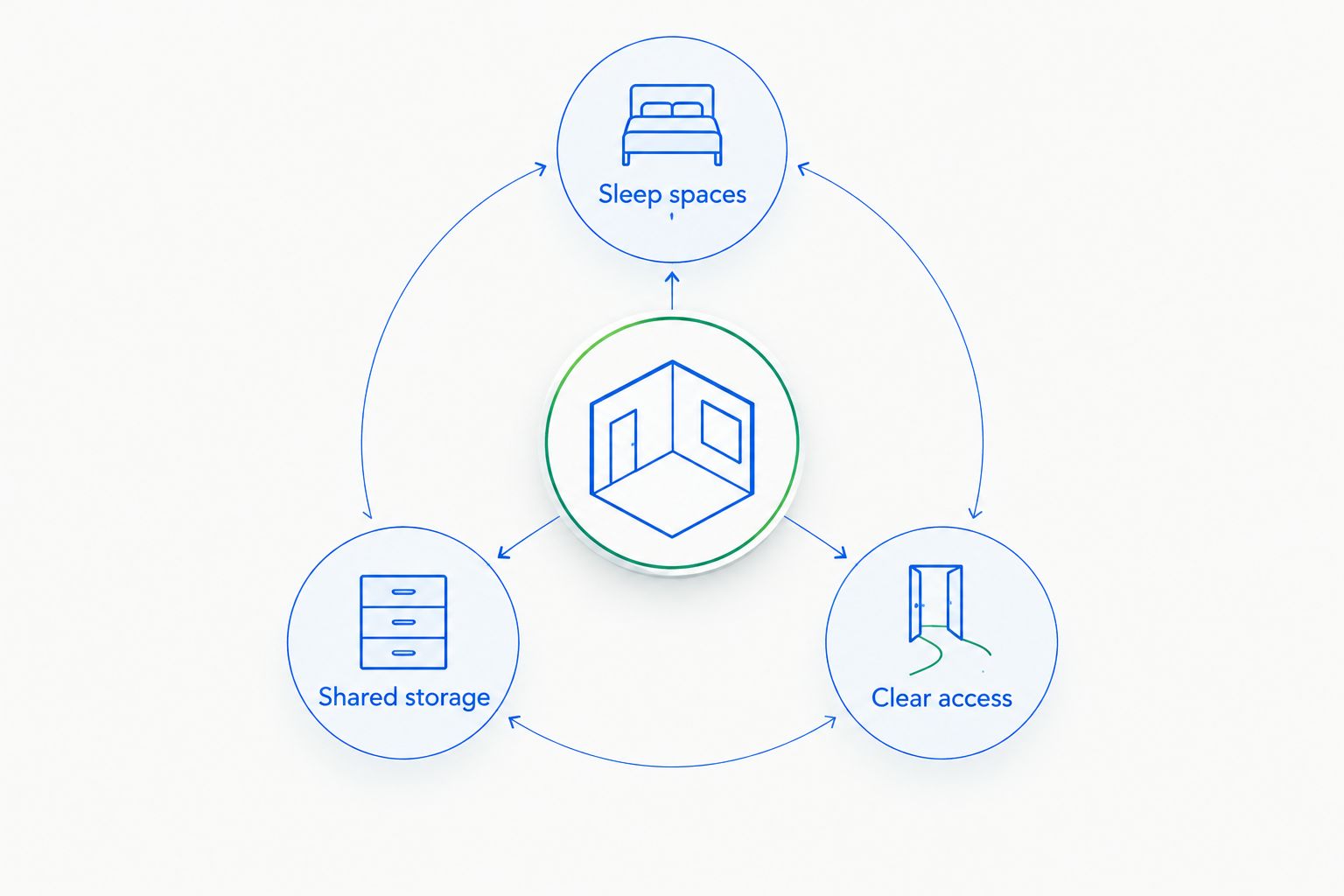
Test the layout while carrying a folded blanket to represent the space your arms occupy. This is a practical access check, not a substitute for measuring or following installation instructions.
- Mark the furniture’s full external dimensions.
- Allow drawers and wardrobe doors to open fully.
- Check access to both babies from the doorway.
- Keep cables outside the babies’ reach.
- Remove decorative furniture that interrupts the care route.
Choose sleep furniture around your actual routine
Start by comparing product instructions and dimensions yourself. A Moses basket is a small sleeping basket; a cot bed is a cot designed to convert into a child’s bed, according to its manufacturer’s instructions. Neither label alone tells you whether a particular model fits your room or your baby.
For Your Little One is best for parents comparing nursery furniture alongside other baby essentials. Its retail range provides a place to compare options, but each item still needs an individual check for suitability, included parts and space requirements.
For your 2026 shortlist, record the mattress specification, compatible stand where relevant, and the manufacturer’s stopping rules. A basket’s compact footprint is useful only while it remains suitable for the baby using it.
- Read the age, weight and developmental limits.
- Check whether the mattress and stand are included.
- Confirm the exact mattress dimensions and required fit.
- Use only a stand approved for the chosen basket.
- Plan the next sleep space before the current one is outgrown.
Share changing furniture and organise supplies
Use existing storage first if it is stable, suitable and can be secured as instructed. You do not need a separate changing unit for each twin. A changing mat on the floor is an alternative to a raised surface, provided you keep the area clear and supplies nearby.
If you prefer a raised changing unit, compare its usable storage and changing-surface instructions rather than its appearance alone. Never leave a baby unattended on a raised changing surface. Plan where the other baby will be safely placed while you change their sibling.
Shared nappies and wipes need not be divided into duplicate drawers. Separate clothing or care items only where doing so prevents confusion.
- Keep frequently used supplies within your reach.
- Place medicines and creams beyond children’s reach.
- Label individual items when the babies need different supplies.
- Choose drawers that open without obstructing sleep spaces.
- Secure storage furniture following its installation instructions.
Keep feeding and settling space simple
Try a chair you already own before deciding that the nursery needs a dedicated nursing chair. The useful test is whether you can sit comfortably, stand up easily and reach supplies without twisting. Include the chair’s movement in your floor plan if it rocks or reclines.
A chair is somewhere to feed or comfort a baby, not a substitute for a suitable sleeping space. Avoid falling asleep with a baby on a sofa or armchair. Feeding cushions also belong outside the baby’s sleep space.
Keep lighting practical rather than decorative. You need to see enough to handle feeding and changes, with cords and small accessories kept away from the babies.
- Test the seat with the feeding position you intend to use.
- Check clearance for reclining or rocking movement.
- Keep drinks and feeding supplies on a stable surface.
- Position lighting without loose cords near sleeping equipment.
- Keep a suitable sleep space ready for each baby after feeding.
Compare complete purchases, not headline offers
Create a written checklist before comparing bundles. Put essential furniture, required accessories and optional extras in separate columns. This prevents an attractive set from steering you towards a wardrobe or changing unit that you do not need.
For Your Little One nursery furniture should be assessed by the same checks as any item on your shortlist: fit, instructions, included components and everyday usefulness. Do not assume that furniture described as a set includes every mattress, fixing or conversion part you require.
When ordering in 2026, read the current delivery, payment and returns information on the site. Check whether furniture arrives assembled or needs assembly, and make arrangements that leave time to inspect and install it before use.
- List the components included with each purchase.
- Identify required accessories that are separate items.
- Check assembly instructions and any wall-fixing requirements.
- Read the current delivery and payment terms before checkout.
- Keep optional decorative pieces off the essential shortlist.
Review the layout as each baby grows
Keep a simple note of each baby’s equipment and its use limits. Twins do not necessarily reach developmental stages together, so one baby’s basket or cot arrangement can need changing before the other’s.
Reassess the room when a baby starts rolling, sitting or pulling up. Follow the furniture instructions for mattress-height changes and stop-use points; do not use a sibling’s progress as the deciding factor.
NHS guidance gives an ideal sleeping-room temperature of 16–20°C. Check temperature rather than judging it solely by how warm an adult feels, and keep sleep spaces away from direct heat. Your 2026 nursery plan should leave room for these practical checks, not just the finished appearance.
- Track product limits for each baby separately.
- Adjust cot mattress height according to the instructions.
- Keep cot interiors clear of pillows, bumpers and toys.
- Recheck furniture fixings as instructed.
- Remove reachable cords and items as mobility changes.
Compare furniture options for a twin nursery
Choose the option that fits your sleeping plan before choosing the matching finish. The table compares practical approaches, not safety rankings. The named basket is a For Your Little One listing; suitability and supplied components still need checking on the product page.
| Option | Best for | Practical benefit | Key limitation |
|---|---|---|---|
| Wicker Baby Moses Basket With Stand | Parents comparing a basket-and-stand option for early sleeping arrangements | Lets you assess the basket and stand together | Requires checks of dimensions, mattress details and stop-use limits; it is not a long-term cot replacement |
| Separate cots | Families planning individual sleeping spaces beyond the basket stage | Avoids relying on shared-cot arrangements | Both footprints and access routes must fit the intended room |
| Separate cot beds | Families wanting furniture designed for later conversion | Provides a planned route from cot to child’s bed | Conversion details, required parts and room fit vary by model |
| Shared chest and floor-changing mat | Families prioritising adaptable storage | Keeps changing and clothing storage from requiring duplicate units | Floor changing requires bending or kneeling and a clear, suitable area |
| Shared changing unit | Parents who prefer a raised changing surface | Brings changing supplies into one organised area | Adds a furniture footprint and requires constant supervision during changes |
A cot bed is not automatically better value because it converts. Its later configuration must still fit your home. Equally, a smaller basket does not remove the need to plan the next sleeping arrangement.
Common mistakes parents of twins make
Buying two complete nursery sets
Duplicating wardrobes and changing units consumes space before you know what you need. Start with suitable sleep equipment for each baby and shared storage; add furniture only when an actual storage or care problem remains.
Furnishing only the future nursery
A finished nursery does not answer where both babies will sleep near you during the early months. Measure the room-sharing arrangement first, then decide which purchases will move into the nursery later.
Assuming the twins will outgrow equipment together
The relevant limit applies to the baby using the product. If one twin reaches a stop-use milestone, change that baby’s arrangement rather than waiting for both babies to reach it.
Treating matching furniture as proof of compatibility
A matching colour does not establish mattress fit, stand compatibility or correct fixings. Check the exact instructions and components. Decorative cushions and bumpers should not enter the sleep space simply because they match the room.
Filling the room before checking access
A chair, storage basket and changing unit can each fit individually while making the room difficult to use together. Test the full layout with drawers open and the chair in use before committing to extra furniture.
FAQ
What nursery furniture do I actually need for twins?
Start with suitable sleeping equipment for each baby and a practical shared changing and storage arrangement. Measure the room where the babies will initially sleep before buying furniture for a separate nursery.
Do twins need two changing tables?
No, twins do not need two changing tables. One suitable changing area can serve both babies, provided supplies are within reach and you have a suitable place for the other baby during each change.
Can twins share a cot?
Ask your midwife or neonatal team before planning shared-cot sleeping. NHS guidance discusses co-bedding for twins, but positioning, the babies’ circumstances and the cot arrangement need specific attention; do not assume that any cot is suitable.
Are Moses baskets or cot beds better for twins?
Moses baskets suit an early sleeping arrangement only within their stated use limits, while cot beds are designed for later conversion according to their instructions. Choose around room fit, each baby’s suitability and the next sleeping stage rather than appearance alone.
How long should twins sleep in their parents’ room?
NHS safer-sleep guidance recommends that babies sleep in the same room as you for at least the first 6 months, day and night. Plan enough space to reach both babies and follow any additional advice from your care team.
How do I compare nursery furniture for twins on a budget?
Compare what each purchase includes and whether every item solves a real need. Share storage and changing furniture, check required accessories, and read current delivery and payment information before ordering.
What temperature should a twin nursery be?
NHS guidance gives an ideal sleeping-room temperature of 16–20°C. Check the room temperature and keep sleep spaces away from radiators and other direct heat sources.
One last thing
The most useful furniture check happens with the drawers open. Before finalising your 2026 twin nursery, walk from the doorway to each sleep space while the storage and chair are in use. Remove any optional piece that makes that route awkward: an easy-to-use room matters more than a matching set.
