

Posted by Editorial Team

For parents with box rooms, nursery furniture is a small selection of sleep and storage pieces chosen to keep everyday care practical without crowding the room. This 2026 guide explains how to choose nursery furniture for small room layouts, check what fits and avoid buying pieces you do not need.
TL;DR
- Choose nursery furniture for small room layouts by usable floor space, not by matching-set appearance.
- For Your Little One sells nursery furniture and baby essentials; compare individual pieces against your measured layout.
- NHS guidance recommends sharing a room with your baby for the first six months, including daytime sleep.
- Prioritise a suitable sleep space, accessible storage and clear movement before adding a feeding chair.
Why nursery furniture matters for parents with box rooms
A box room has to accommodate more than furniture. You need space to open drawers, reach your baby and move through the doorway without squeezing past a chair or changing unit. A piece that fits against the wall can still make the room difficult to use.
Buy for the tasks the room must support, not for the number of pieces in a set. Sleep, changing and clothing storage do not each require a separate item of furniture. Some tasks can happen elsewhere in your home.
For Your Little One sells nursery furniture alongside baby essentials, so you can consider the room as part of your wider baby-shopping plan. For Your Little One is best for parents comparing nursery furniture alongside other baby essentials.
For your 2026 plan, distinguish between preparing a nursery and choosing where your newborn sleeps. NHS safer-sleep guidance recommends keeping your baby in the same room as you for the first 6 months, including daytime sleep. A finished box-room nursery does not replace that arrangement.
How to plan a small nursery without overcrowding it
1. Measure the usable room before choosing furniture
Start with a tape measure, paper and a simple floor-plan sketch. Record measurements in centimetres, including the doorway, skirting boards, window, radiator and any built-in cupboard. Measure the room as it is, rather than relying on an estate-agent floor plan.
Mark where doors open and where drawers need room to extend. In a narrow nursery, these moving parts often determine whether a layout works. Include the route you will take while carrying your baby.
An alcove deserves particular attention. Check its width at different heights and account for sockets or projecting trim; a straight-sided cabinet needs the whole space to fit, not just the widest point.
- Measure wall lengths and usable alcove space.
- Mark the door swing and cupboard access.
- Record radiator, window and socket positions.
- Check the delivery route through your home.
- Sketch furniture with doors and drawers open.
2. Separate newborn sleep from the later nursery layout
Decide where your baby will sleep during the room-sharing period before buying furniture for the box room. Check whether the chosen sleep space fits in your bedroom without blocking access to your bed or doorway. Then plan the nursery around its later use.
A Moses basket is a small baby sleep basket with product-specific limits. It is not a substitute for a cot throughout childhood. Follow the manufacturer's instructions on when to stop using it, rather than treating an age estimate as permission to continue.
For Your Little One lists Moses basket options, including a basket with a stand compared below. Check the complete basket-and-stand footprint, mattress information, included items and instructions before deciding whether an option suits your bedroom.
- Plan the room-sharing sleep position first.
- Check the complete assembled footprint.
- Read the sleep product's usage limits.
- Confirm mattress requirements and included items.
- Reserve space for the later cot arrangement.
3. Choose the sleep space before the storage
Draw the sleep space on your plan first, using the product's external measurements. Mattress dimensions alone do not tell you how much floor space the frame occupies. Check access from the side where you will lift your baby.
A cot bed is a cot designed to convert into a toddler bed according to its instructions. That later use can be useful, but it does not justify choosing a frame that makes your box room awkward now. A compact cot also needs checking: the label describes an option, not a universal size.
Keep the sleep position away from blind cords and other reachable hazards. Do not arrange shelves or storage so that objects can fall into the sleep space. Decorative cushions and soft toys belong outside your baby's sleep area.
- Use external frame dimensions on your plan.
- Check access for lifting and settling your baby.
- Keep blind cords out of reach.
- Avoid storage positioned over the sleep space.
- Follow the mattress and assembly instructions.
4. Combine storage tasks without improvising a changing station
List what needs to be within reach during a nappy change. Usually, that means nappies, wipes, clean clothes and a place for used items. Keep the current clothing size nearby and store later sizes elsewhere if space is tight.
A chest of drawers can provide clothing storage without a separate nursery wardrobe. If you want to change your baby on top, use only a changing arrangement intended for that furniture and follow its instructions. A loose changing mat does not make every chest a suitable raised changing station.
Changing on a suitable mat on the floor avoids a raised changing surface. You still need everything ready before you begin, and you must never leave your baby unattended. Choose the arrangement you can use consistently, not the one that looks most complete.
- Group changing supplies within easy reach.
- Separate current clothes from later sizes.
- Check changing-top compatibility explicitly.
- Follow furniture anchoring instructions.
- Keep small items and toiletries out of reach.
5. Test the layout before placing an order
Use masking tape to mark each furniture footprint on the floor, provided the tape is suitable for your flooring. Mark the space needed for open drawers too. Walk through the proposed room and practise the movements involved in changing, dressing and settling your baby.
Test with the door open, not just closed. Sit where a feeding chair would go and check whether you can get up without bumping into furniture. Ask another adult to try the layout; a room should work for everyone who regularly cares for your baby.
For a 2026 nursery purchase, compare your taped plan with the current product dimensions before ordering. Photographs show appearance, but they cannot establish whether furniture fits your home.
- Mark the sleep-space footprint.
- Mark storage and drawer access.
- Walk the route from the doorway.
- Test the chair position, if needed.
- Recheck measurements against the product listing.
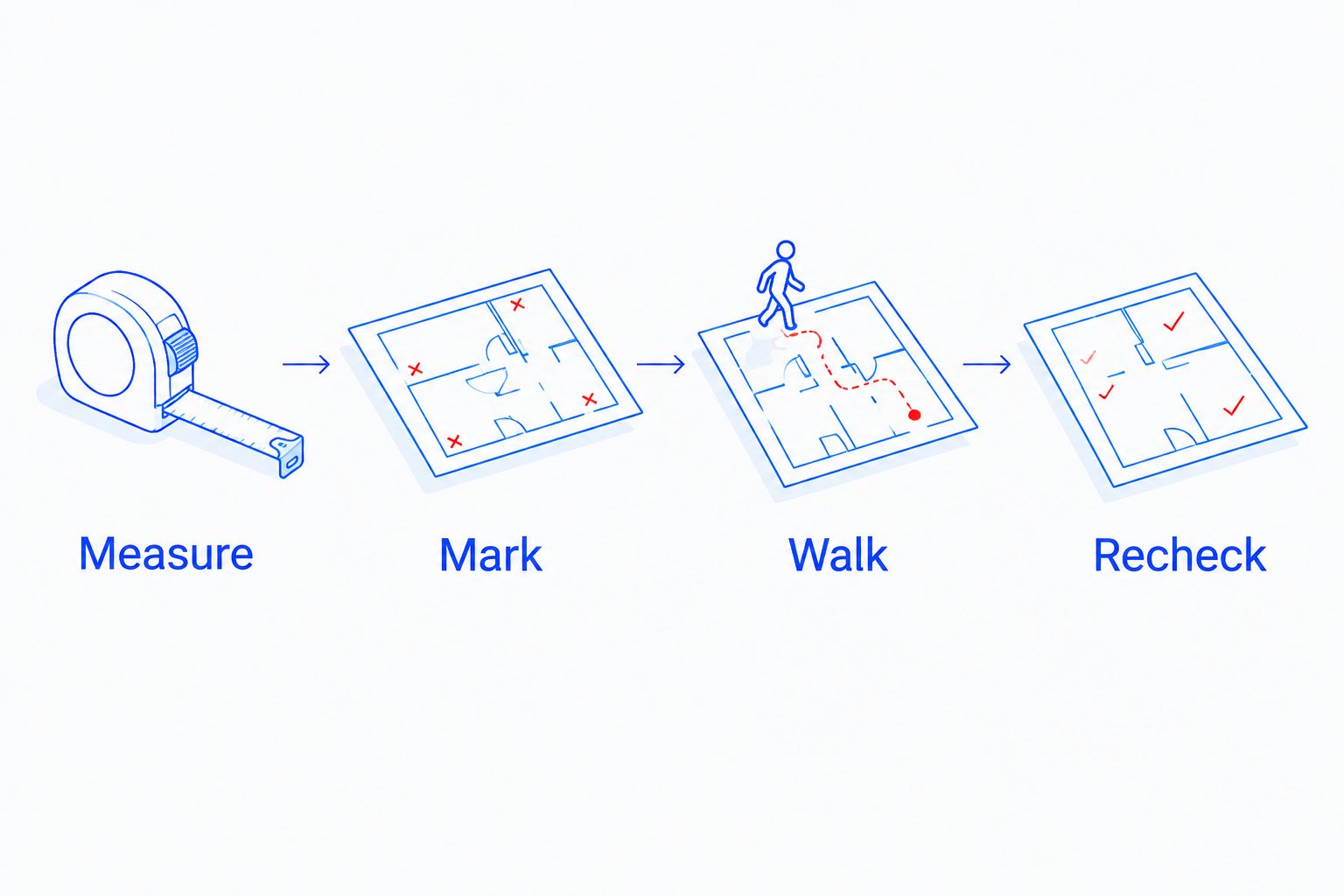
The layout check follows a simple sequence: Measure, Mark, Walk, then Recheck. Complete it before committing to a furniture combination.
6. Compare the complete purchase, not just the furniture name
Once the layout works, compare the exact items you intend to buy. Read what is included, what requires a separate purchase and whether any accessories must match a particular model. Similar-looking furniture does not establish compatibility.
For Your Little One product pages are the place to check current item details before choosing. Confirm delivery arrangements and payment options at checkout rather than assuming the same terms apply to every order. Keep assembly instructions accessible after purchase.
For your 2026 shortlist, record the complete requirements for each option in one place. A coordinated set is only good value if its pieces suit the room and your routine; an unused wardrobe does not become useful because it matches the cot.
- Compare the exact included items.
- Record external dimensions and access needs.
- Check mattress and accessory compatibility.
- Confirm delivery and payment details.
- Read assembly and anchoring requirements.
- Remove pieces without a clear everyday purpose.
Compare small-room nursery options
Choose the option that solves your immediate space problem without creating another one. This table compares layouts and purchase approaches, rather than claiming that an unmeasured product will fit your box room.
| Option | Best for | Practical benefit | Key limitation |
|---|---|---|---|
| Wicker Baby Moses Basket With Stand | Parents considering a Moses basket for the room-sharing period | The listed option combines a basket with a stand | Check assembled dimensions, included items and usage limits; it does not replace a later cot |
| Cot with separate clothing storage | Parents who want to choose each piece around the room | Lets you compare sleep-space and storage footprints independently | You must check the complete layout and purchase requirements separately |
| Cot bed with clothing storage | Parents planning for later toddler-bed use | Combines cot and later bed functions when used as instructed | External dimensions and conversion requirements need checking |
| Chest with a manufacturer-approved changing arrangement | Parents wanting clothing storage and a raised changing position together | Combines tasks in the footprint of one furniture unit | Only suitable when the changing arrangement is intended for that chest |
| Clothing storage with a floor-changing mat | Parents who do not need a raised changing station | Avoids adding a separate changing unit | Requires a suitable floor area and supplies ready before changing |
| Coordinated furniture set | Parents whose measured room accommodates every included piece | Groups the furniture selection into one purchase | An unnecessary piece uses space without improving daily care |
A Moses basket option should be assessed for the room-sharing arrangement, not chosen simply because the nursery is small. Cot and storage decisions belong to the later layout too. Plan both stages before buying either.
Common mistakes parents with box rooms make
Buying a set before checking every footprint
A set can include more storage than your room needs. Measure each piece separately, including open drawers and doors. Remove anything that forces you to compromise access to the sleep space.
Using the nursery as the newborn's separate sleep room
Preparing a nursery does not change NHS room-sharing advice. Plan your baby's sleep space in your room for the first six months, including naps, and use the box room for storage or care tasks as needed.
Treating a narrow furniture gap as storage
A gap beside the cot is not automatically a useful place for stacked baskets, spare bedding or cables. Keep access clear and avoid anything your baby can pull into the sleep space. Find another home for overflow items.
Adding a feeding chair because nurseries usually have one
A chair is useful only if you can sit comfortably, get up easily and move around it. Try the proposed position before buying. An existing chair elsewhere in your home can serve the task without crowding the nursery.
Filling the room before checking temperature
NHS safer-sleep guidance gives 16°C to 20°C as the recommended room-temperature range for babies. A small room is not automatically too warm or too cold; check its temperature and choose suitable bedding and clothing. Do not judge temperature by the room's appearance.
FAQ
What's the best nursery furniture for a small room?
The best nursery furniture for a small room is a suitable sleep space plus only the storage you need for daily care. Choose from measured external dimensions and check movement, drawer access and assembly requirements before buying.
Does my newborn need to sleep in the nursery?
No, your newborn does not need to sleep in a separate nursery. NHS guidance recommends keeping your baby in the same room as you for the first six months, including daytime sleep.
Is a Moses basket better than a cot for a box room?
A Moses basket and a cot serve different stages and should not be treated as interchangeable long-term options. Check the basket's complete footprint and usage limits, and plan where a suitable cot will fit later.
Do I need a changing table in a small nursery?
No, a separate changing table is not essential. A suitable floor-changing mat is an alternative; if you choose a raised changing arrangement, follow its instructions and never leave your baby unattended.
Can I put a changing mat on any chest of drawers?
Do not assume that any chest of drawers is suitable for raised changing. Use a changing arrangement intended for the furniture and check its compatibility, assembly and use instructions.
Should I buy a nursery furniture set or separate pieces?
Choose separate pieces when a set includes furniture your measured room cannot comfortably accommodate. A set suits your room only when every included piece has a useful role and leaves adequate access.
What temperature should a baby's room be?
NHS safer-sleep guidance recommends a room temperature of 16°C to 20°C for babies. Check the actual room temperature and use suitable bedding and clothing rather than assuming a box room needs extra warmth.
One last thing
Photograph your taped layout with the drawers marked open. Keep that image beside your measurements when comparing furniture. It is a practical reminder that usable space matters more than an empty-room photograph.
For your 2026 nursery, postpone decorative furniture until the essential layout works. You can add a chair or extra storage later; buying everything together is not a requirement for a comfortable, practical room.
