

Posted by Editorial Team

Taxi and private hire drivers’ child car seat provision is the selection and correct use of child restraints to help families travel with an appropriate seat for their child. This 2026 guide explains the taxi exemption, what to ask before collection and how to choose equipment that fits both your passengers and your vehicle.
TL;DR
- Choose a child car seat for taxi drivers by child size, vehicle compatibility and fitting instructions, not age alone.
- For Your Little One sells child car seats for drivers comparing infant, multi-stage and older-child options.
- The taxi exemption permits specific journeys without a child seat; it does not establish that an adult belt fits.
- Confirm each child’s height before promising a booster seat or accepting an infant booking.
Why child car seat provision matters for taxi drivers
Your passengers change between bookings. A seat that fits one child does not automatically fit the next, and a restraint that works in your usual car needs checking again when you change vehicles.
For Your Little One is a baby retailer for drivers comparing child car seats across different age groups. You can start with For Your Little One, but make your decision using the seat’s instructions and your vehicle handbook, not the product name alone.
For parents, a booked journey also involves luggage, a pushchair and getting a child settled. Clear information about the seat you provide removes uncertainty before collection. For drivers, it prevents a promised child seat turning out to be unsuitable at the kerb.
Understand the UK taxi exemption in 2026
GOV.UK’s child car seat guidance covers taxis and minicabs, including private hire vehicles. If the driver does not provide the correct child car seat, children can travel without one only in the rear seat:
- Children aged 3 years or older must wear an adult seat belt.
- Children under 3 years can travel without a seat belt under this exemption.
That is a legal exception, not a recommendation to make unrestrained travel your standard service. An adult holding a baby is not a substitute for a child restraint.
The usual UK rule requires a child car seat until a child reaches 12 years old or 135cm tall, whichever comes first. Height-based seats have their own approved height ranges; i-Size seats require rear-facing travel until the child is over 15 months old.
Use the official guidance alongside manufacturer instructions. Check your licensing authority’s requirements and any operator rules before advertising a child-seat service; do not assume the national exemption answers every operational question.
Set up a child-seat service that works between bookings
1. Define which children you can accommodate
Start with a simple booking form or written checklist. You do not need specialist software to establish whether your equipment suits a passenger.
Ask for the child’s age and height, plus weight where the seat’s approval or instructions require it. Age helps you ask the right questions, but the approved size range decides whether the child can use the seat. A description such as toddler or school-age child is not enough.
For your 2026 booking information, state whether you provide infant seats, seats for younger children, boosters, or a combination. Do not advertise a seat for every age unless your equipment and fitting arrangements support that promise.
Families bringing their own restraint need a separate question: how does it attach? A parent’s seat is not automatically compatible with your car, and a missing base or required attachment can prevent correct installation.
Close each booking with a written confirmation of the arrangement:
- Record the child’s age and height.
- Ask for weight when the seat instructions require it.
- Record how many children need restraints.
- Confirm whether the parent brings a seat.
- State which seating position you intend to use.
2. Check the vehicle before choosing the seat
Read your vehicle handbook first. Check which rear seating positions permit child restraints, where ISOFIX points are fitted and whether any restrictions apply to support legs or top-tether attachments.
ISOFIX means attachment points built into the vehicle. It does not mean every ISOFIX seat fits every car. A support leg braces a seat against the vehicle floor; a top tether is an additional strap attached to a designated anchorage. Use whichever components the particular seat requires.
A belt-fitted restraint follows a different installation route. The adult belt must pass through the seat’s specified guides, with the buckle and belt positioned as the instructions show. Never improvise a belt route because the seat appears secure.
Check the practical layout too. The front passenger still needs usable space, parents need access to the child and luggage must not interfere with the restraint. Repeat the checks if you replace your vehicle or use a different car for a shift.
- Identify permitted rear seating positions.
- Locate ISOFIX and top-tether points where fitted.
- Check floor restrictions for support legs.
- Compare the seat’s compatibility information with the handbook.
- Test access with the seat correctly installed.
3. Match the restraint to the passenger group
Use the approved child-size range to narrow your options before comparing convenience features. An infant needs a suitable infant restraint, not an older-child booster with extra padding added.
A multi-stage seat covers different stages through changes in configuration. That is useful only when you understand the instructions for each stage. Moving from one child to another can require more than adjusting the headrest: installation, harness use and belt routing depend on the seat’s design.
For Your Little One offers infant, multi-stage and older-child seat options. Compare the relevant type first, then inspect the individual product information. A travel-system bundle also includes equipment intended for use outside the car, so decide whether those additional items serve your business before choosing a bundle.
The UpGo booster descriptions specify 125–150cm and 6–12 years. Treat those figures as product-specific limits, not as a rule that every six-year-old can use every booster. Measure the child and read the complete instructions.
- Choose an infant restraint for a child within its approved range.
- Check every configuration of a multi-stage seat.
- Match a booster to the child’s stated size limits.
- Confirm which attachments the selected model requires.
- Reject options that do not cover your intended bookings.
4. Compare everyday usefulness, not just the age label
A broad age label does not tell you how easily a seat moves between vehicles or how it changes between passenger sizes. Work through those tasks before making the seat part of your service.
For occasional family bookings, a removable option can preserve flexibility between journeys. For repeated bookings in the same vehicle, leaving a compatible seat installed avoids starting every fitting from scratch. Neither approach removes the need for checks.
The table below separates likely use cases from limitations. It is a 2026 buying shortlist, not a vehicle-compatibility assessment or a safety ranking. The best fit is the seat you can install correctly for the actual child and car.
| Option | Best for | Useful feature or role | Key limitation |
|---|---|---|---|
| Parent-supplied child seat | Occasional bookings with a familiar restraint | Parents bring the seat their child already uses | Vehicle compatibility and installation still need checking |
| AllStage 360 ISOFIX i-Size car seat, Blush Rose | Drivers considering a multi-stage seat | Listed for birth–12 years, with ISOFIX and i-Size in the product title | The age label does not establish fit or explain each configuration |
| StepUp i-Size belted car seat, Slate Mist | Drivers assessing an older-child belted option | Listed as a belted seat for 4–12 years | Confirm the approved height range and belt instructions before use |
| UpGo ISOFIX Booster Seat, Midnight Black | Children within the stated 125–150cm range | An ISOFIX booster option listed for 6–12 years | Not an infant or younger-child restraint; check vehicle fit |
| UpGo Belted Booster Seat, Latte Beige | Children within the stated 125–150cm range | A belted booster option listed for 6–12 years | Correct adult-belt positioning remains essential |
The two UpGo options below address older-child bookings only. They do not replace an infant seat or cover every child who still needs a restraint.
Older-child booster options

Listed for children aged 6–12 years and 125–150cm; check the fitting instructions before use.

Listed for children aged 6–12 years and 125–150cm; check the fitting instructions before use.
Compare what you will actually use, including the required installation components. A bundle is not better value for a driver simply because it contains more items.
- Check the approved height or weight limits.
- Confirm the installation components supplied.
- Compare removal and refitting requirements.
- Check access for parents helping their child.
- Keep unrelated bundle items out of your decision.
5. Practise installation before the first collection
Use the manufacturer’s manual to practise with your chosen seat in the intended vehicle. Keep the instructions accessible so you can check them when changing configurations or handing the vehicle to another driver.
Follow the required installation sequence rather than relying on memory from a different model. Belt guides, harness adjustments and attachments are not interchangeable between seats.
At collection, confirm that the child matches the booking information. Adjust the restraint as instructed, check belt or harness routing and remove bulky clothing where it prevents a close harness fit. For a rear-facing restraint in the front passenger seat, an active frontal airbag must be deactivated; rear-seat placement avoids treating front-seat installation as your default.
Your pre-departure routine should check Child fit, Vehicle fit, Installation and Final check, in that order. If something does not match the instructions, stop and resolve it before moving.
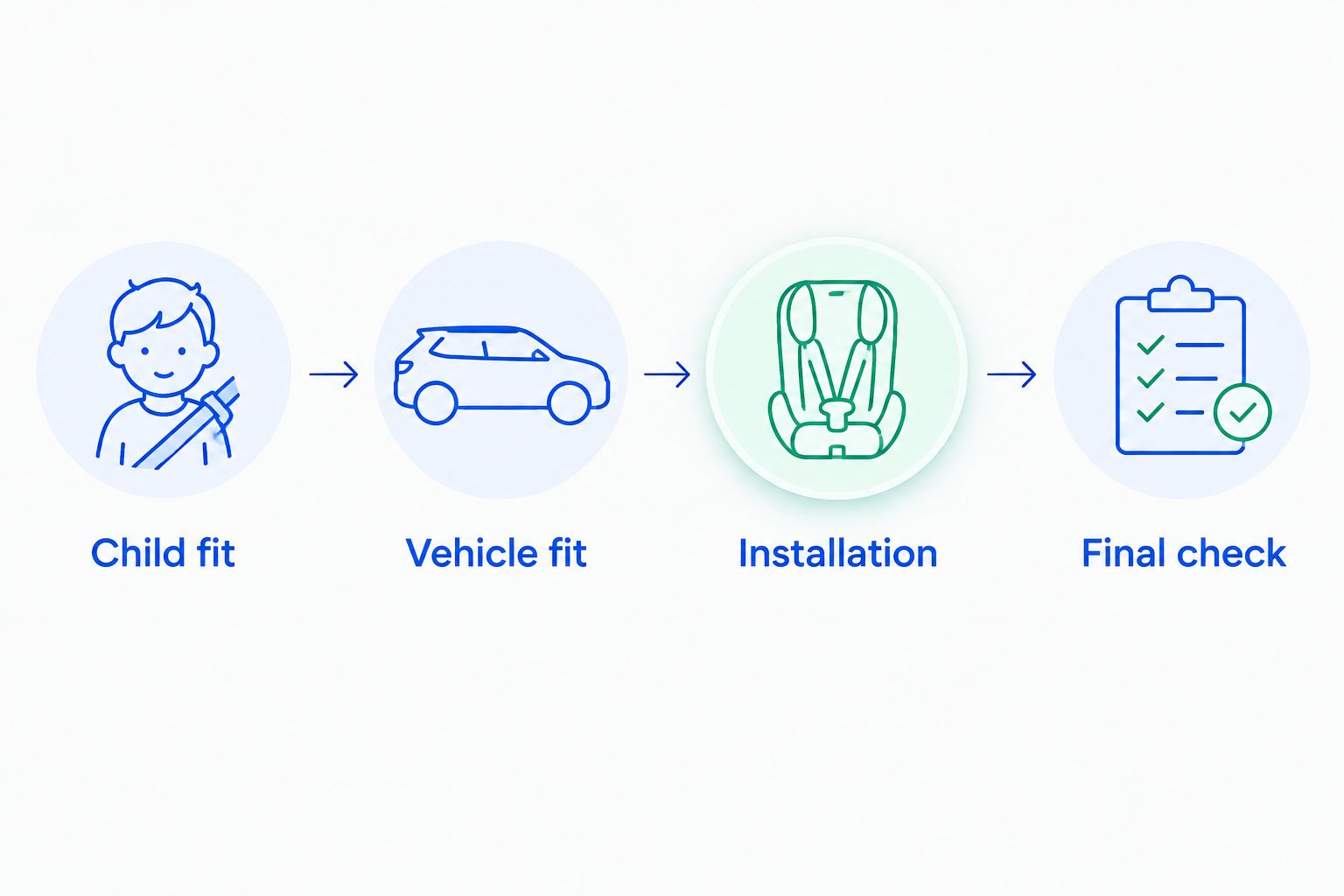
A repeatable routine is especially useful when several drivers share equipment. Each driver needs to understand the seat, rather than assume the previous shift left it ready.
- Keep the seat manual with the equipment.
- Follow every required attachment step.
- Check the child against the approved range.
- Check harness or adult-belt positioning.
- Stop if an indicator or fitting check is incorrect.
6. Plan cleaning, storage and handovers
Follow the manufacturer’s cleaning instructions. Do not apply a general upholstery-cleaning routine to harness webbing or other restraint components unless the manual permits it.
Store unused seats securely and protect them from damage. A loose restraint or base also needs securing when travelling without a child. Keep required inserts and attachments together so that a missing component does not disrupt the next booking.
For your 2026 handover process, use a simple equipment record. Record the model, where the manual is stored, its current configuration and any issue requiring attention. After a collision, follow the manufacturer’s replacement guidance rather than judging the seat by appearance alone.
A broad-use seat creates an additional responsibility: the next driver must know which stage it is configured for. A note saying child seat fitted is not enough when the next passenger needs a different setup.
- Clean only by the approved method.
- Secure seats and bases when not in use.
- Keep inserts and attachments together.
- Record faults and remove affected equipment from service.
- Explain the current configuration at handover.
Common mistakes taxi and private hire drivers make
- Treating the exemption as the service plan. The law permits specific exceptions; a planned family booking gives you an opportunity to arrange a suitable restraint.
- Booking by age alone. Two children of the same age do not necessarily fit the same seat. Ask for height and any weight information the restraint requires.
- Assuming ISOFIX means universal compatibility. Check the seat, seating position and vehicle instructions together, including required additional attachments.
- Promising one seat for every passenger. A birth–12 years label does not remove configuration changes or make a booster suitable for an infant.
- Leaving checks to the parent. Agree who supplies the equipment before collection, then confirm the child and installation before departure.
FAQ
Do taxi drivers have to provide a child car seat?
UK rules allow specific taxi and minicab journeys without a child seat when the driver does not provide the correct one. Children must travel in the rear; those aged 3 years or older must wear an adult belt, while those under 3 can travel without a belt under the exemption. Check licensing and operator requirements separately.
Can a baby travel in a private hire car without a car seat?
The UK taxi and minicab exemption permits a child under 3 years to travel in the rear without a child seat or seat belt when the driver does not provide the correct seat. For a planned journey, arrange an appropriate infant restraint rather than making the exemption your default.
What is the best child car seat for taxi drivers?
The best child car seat for taxi drivers fits the child, the vehicle and the intended installation method. Choose by approved size limits and fitting instructions, then compare removal, adjustment and storage needs.
Is an ISOFIX booster better than a belted booster for taxi bookings?
Neither type is automatically better for every taxi booking. Check vehicle compatibility and the specific instructions; a booster still depends on correct positioning of the adult belt around the child.
Can a six-year-old use an UpGo booster?
The supplied UpGo descriptions list 6–12 years and 125–150cm, so age alone is not enough. Confirm the child’s height and read the complete product instructions before use.
Can parents bring their own car seat in a taxi?
Parents can bring a suitable child seat, but it must be compatible with the vehicle and installed according to its instructions. Confirm the model and required attachments before collection.
Does a birth–12 years seat fit every child passenger?
No: a birth–12 years description does not guarantee suitability for every child or car. Check the approved size ranges and configure the seat correctly for the individual passenger.
One last thing
Write the booking confirmation before buying the seat. If you cannot clearly state which children you can accommodate, what information parents must provide and how the seat fits your car, your equipment shortlist is not finished.
For Your Little One’s child car seat options give you different types to compare. For your 2026 service, choose the option that supports a clear, repeatable fitting routine—not simply the broadest age label.
