

Posted by Editorial Team

Twins change the maths on a travel system: you're not choosing one pram, you're choosing a setup that works twice over, in one car boot, on one budget.
For most families, the best travel system for twins in 2026 isn't a single double pushchair — it's two matching (or complementary) single systems bought as a pair. Best overall pair for two-car households: the For Your Little One Cruise 3-in-1 Travel System with ISOFIX Base in Eclipse Black, bought twice. Best budget pairing when one car does both school runs: the Cruise 3-in-1 without a base. Best for the newborn stage: the Qubi Infant Car Seat Stroller. This guide breaks down why, and where each option actually earns its place.
TL;DR
- The best travel system for twins in 2026 is usually two single systems bought in pairs, not one double pushchair.
- The Cruise 3-in-1 Travel System with ISOFIX Base suits families with two cars who each want quick car seat swaps.
- The Qubi Infant Car Seat Stroller is the lighter option for the newborn stage with two babies to lift.
- The AllStage 360 car seat covers birth to 12 years, cutting how many times you rebuy per child.
- Check your car's back-seat width before buying two of anything with a base fitted.
Why this matters
For Your Little One doesn't stock a dedicated double or tandem pushchair, and that's actually the more common route for twin parents anyway: two identical (or two different) single travel systems, each doing one baby's job.
The reason is practical, not just a stock gap. A single wide double pushchair is harder to fit through shop doorways, harder to lift into a car boot, and locks both children into the same nap and feed schedule. Two single systems let one parent take one baby out while the other stays home, and they fit standard boots that a side-by-side double often won't.
For Your Little One says it's trusted by over 2 million customers, and the same Cruise 3-in-1 range that single-baby families buy is exactly what most twin parents end up duplicating.
What makes the best travel system for twins
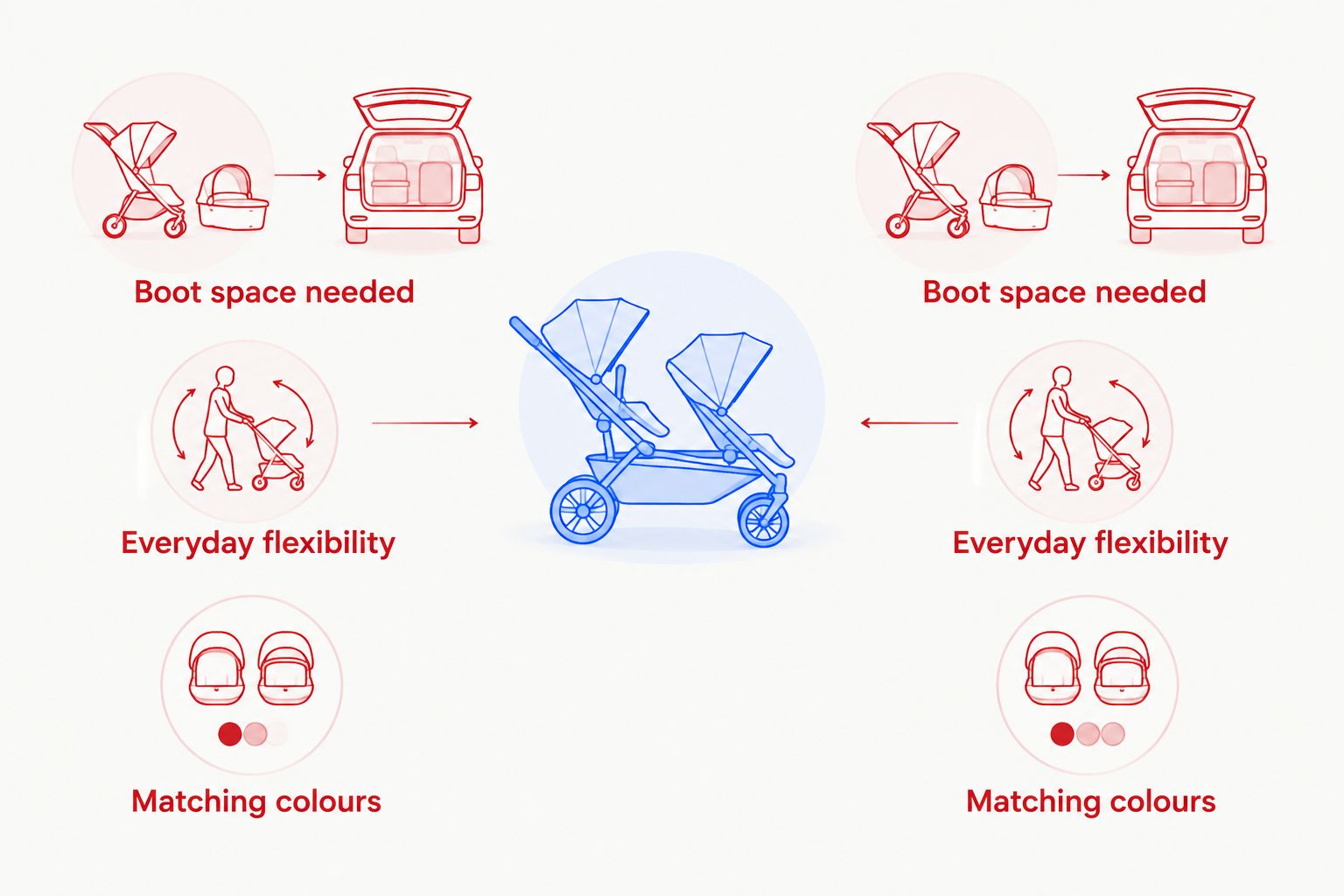
Before comparing products, these are the things that actually decide whether a twin setup works day to day:
- ISOFIX base availability — a fixed base stays in the car, so the car seat clicks in without a seatbelt each time; useful when you're loading two seats in a hurry
- Stage coverage — how long one seat lasts before you need to buy again, especially with two children going through the same stages together
- Fold size and weight — two full-size systems take up real boot space; a lighter second option matters once car seats come out
- Colour or trim differentiation — an easy way to tell which pram belongs to which twin without labelling anything
- Car seat rotation — 360-degree rotating bases make loading two children through one door faster
- Compatibility across ages — whether the same system works from newborn through toddler, or needs swapping out
At a glance
| System | Best for | Standout feature | Key limitation |
|---|---|---|---|
| Cruise 3-in-1 with ISOFIX Base (Eclipse Black) | Two-car households | Base stays fitted, car seat clicks straight in | Needs a base bought for each car |
| Cruise 3-in-1, no base (Blush Rose) | One shared car, one budget | Same 3-in-1 modular setup, lower outlay | Seatbelt-fit only without a separate base |
| Qubi Infant Car Seat Stroller | The newborn stage | Lighter and more compact than a full system | Not built for the toddler stage |
| EZLite Lightweight Travel Stroller | Toddler-stage second buggy | Compact fold, easy to lift one-handed | No car seat compatibility |
| AllStage 360 car seat | Long-term use without rebuying | Birth to 12 years in one seat, 360-degree rotation | Bulkier than an infant-only seat in the back row |
1. Cruise 3-in-1 Travel System with ISOFIX Base (Eclipse Black): best overall pair for two-car families
This is a 3-in-1 modular system — pram, pushchair and i-Size car seat in one — with an ISOFIX base included, plus a free cupholder and seat liner. Running two of these means each car keeps its own base fitted permanently, so the car seat locks in without threading a seatbelt through it every time.
That matters more with twins than with one baby, because you're doing the same fiddly job twice, usually with one child already crying in the other seat.
Cruise 3-in-1 (ISOFIX Base) pros:
- Base stays fixed in the car for a quick click-in car seat swap
- Full 3-in-1 setup covers newborn through toddler stages
- Cupholder and seat liner included as standard
- Matching Eclipse Black colourway if you want both twins' systems identical
Cruise 3-in-1 (ISOFIX Base) cons:
- Buying two full setups with a base each is the priciest way to duplicate this system
- Two full-size 3-in-1 units take up more boot space than a lightweight pair
- Identical colourways mean you'll need another way to tell the seats apart
Best for: families running two cars who want each one ready to go without moving a base between them. Verdict: Buy.
2. Cruise 3-in-1 Travel System, no base (Blush Rose): best when one shared base is enough
Same modular 3-in-1 build as above — pram, pushchair, i-Size car seat, cupholder and seat liner included — but without an ISOFIX base bundled in. The car seat fits with a vehicle seatbelt, or with a base bought separately later.
If both children's car seats mostly live in the same car and go in one at a time, this cuts the cost of duplicating a base you don't need twice.
Cruise 3-in-1 (no base) pros:
- Same 3-in-1 flexibility as the ISOFIX version
- Lower up-front cost than buying two bases
- Blush Rose trim makes it easy to spot which seat is which
- Cupholder and seat liner included
Cruise 3-in-1 (no base) cons:
- Fitting with a seatbelt each time is slower than a permanent base
- Still a full-size system to store and fold twice over
Best for: one car, one shared installation routine, and a lower spend on the second setup. Verdict: Buy.
3. Qubi Infant Car Seat Stroller (Grey Olive): best for the newborn stage
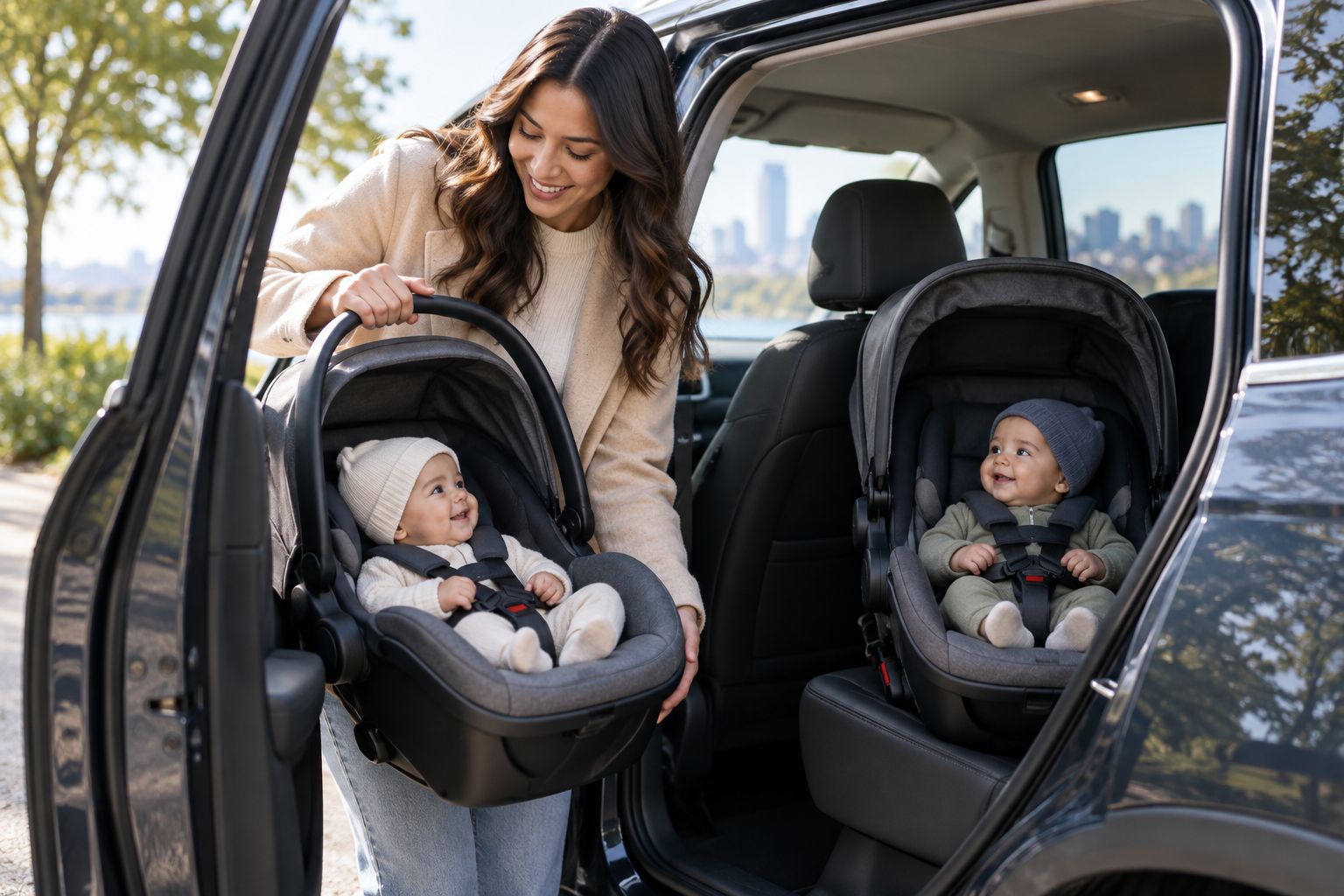
The Qubi pairs an infant car seat with a stroller frame in a lighter, more compact build than the full 3-in-1 Cruise range. In the newborn months, when both twins are being lifted in and out of the car constantly, weight and fold size matter more than modularity.
Qubi pros:
- Lighter to lift than a full travel system
- Compact fold suits a smaller boot holding two units
- Quicker to set up for short trips
Qubi cons:
- Less suited to the toddler stage than the Cruise 3-in-1 range
- Fewer modular positions than a full 3-in-1 system
Best for: the first months with twins, before either child needs a toddler seat or pushchair mode. Verdict: Buy for the newborn stage, then reassess.
4. EZLite Lightweight Travel Stroller (Midnight Black): best second buggy once twins are toddlers
Once twins outgrow their infant car seats, a full 3-in-1 system isn't always the most practical thing to fold twice for a quick trip to the park. The EZLite is built as a lightweight, compact-fold stroller for exactly that stage.
EZLite pros:
- Compact fold, easier to lift one-handed than a full pushchair
- Useful as a spare for grandparents' cars or trips away
- Lighter day-to-day than running two full-size systems everywhere
EZLite cons:
- No car seat compatibility, so it can't cover the newborn stage alone
- Not a first system if you need something from birth
Best for: the toddler stage, or as a second, lighter buggy alongside a full travel system. Verdict: Buy as a companion, not a first purchase.
5. AllStage 360 Car Seat (Midnight Black, birth to 12 years): best for extending use without rebuying
The AllStage 360 is rated from birth to 12 years and rotates 360 degrees, which makes loading a wriggling toddler through one car door noticeably easier than lifting them past a fixed-facing seat.
With twins, buying two of these instead of two separate seats at each age bracket means one purchase per child covers the whole run from infant carrier to booster stage.
AllStage 360 pros:
- Birth to 12 years in one seat, so no rebuying at each age stage
- 360-degree rotation eases loading two children through the same door
- Pairs well with a lightweight stroller once the pram stage ends
AllStage 360 cons:
- A rotating base seat is bulkier in the back row than an infant-only seat
- Running two takes up more back-seat width — check your car fits both before ordering
Best for: parents who want one car seat purchase per child that lasts the distance. Verdict: Buy.
Systems worth comparing side by side

3-in-1 travel system with ISOFIX base, free cupholder and seat liner included.
£219.99

3-in-1 travel system with ISOFIX base in Pebble Sage, cupholder and seat liner included.
£219.99

Lightweight, compact-fold stroller for quick trips at home or away.
£39.99
How we ranked these
Each system was weighed against the criteria above: base availability, stage coverage, fold size and weight, colour differentiation, rotation, and how well it holds up to being bought twice rather than once. Items further down the list — the EZLite in particular — get a shorter writeup because they're a companion piece, not a standalone first purchase.
Which travel system should you choose for twins in 2026?
If you're still deciding: run two cars and want each one ready without swapping a base, buy the Cruise 3-in-1 Travel System with ISOFIX Base in Eclipse Black, twice. If one car handles both children and budget matters more than convenience, the no-base Cruise 3-in-1 in Blush Rose does the same job for less outlay per pair. If you're still at the newborn stage, start with the Qubi and reassess once both children are ready for a toddler seat.
FAQ
What is the best travel system for twins in 2026?
There's no single universal answer, but the Cruise 3-in-1 Travel System with ISOFIX Base, bought as a pair, covers most two-car households well in 2026. Families sharing one car often do better with the no-base version instead.
Do twins need two of the same travel system, or a double pushchair?
Most twin parents use two single travel systems rather than one double pushchair, because two singles fit standard car boots and let each baby be taken out separately. A double pushchair is wider and harder to manoeuvre through doorways.
Is an ISOFIX base worth it for twins?
Yes if both car seats need to go in and out of the same car regularly, since the base stays fixed and the seat clicks straight in. If the seats mostly stay in one car and are used one at a time, a shared base or seatbelt fit can work just as well.
Can twins have different coloured travel systems?
Yes, and it's a practical way to tell the two systems apart at a glance. The Cruise 3-in-1 range comes in colourways including Eclipse Black, Blush Rose, Dune Beige and Pebble Sage.
What's the difference between a 3-in-1 travel system and an infant car seat stroller?
A 3-in-1 system like the Cruise converts between pram, pushchair and car seat modes and is built to last from newborn to toddler. An infant car seat stroller like the Qubi is lighter and more compact but suits the newborn stage rather than the full toddler range.
How much boot space do two travel systems need?
Two full-size 3-in-1 systems take up noticeably more boot space than a single one, which is why some parents pair a full system with a lighter second stroller such as the EZLite once one twin reaches toddler stage.
What car seat lasts the longest for twins?
The AllStage 360 is rated from birth to 12 years, which means one seat purchase per child rather than rebuying at each age bracket. Its 360-degree rotation also makes loading two children through one car door easier.
Is a lightweight stroller enough for twins?
A lightweight stroller like the EZLite works well as a second buggy once twins are past the car seat stage, but it isn't a substitute for a full travel system from birth since it has no car seat compatibility.
One last thing
The detail most twin parents miss until they're already at the till: check your car's back-seat width before buying two car seats with bases fitted side by side. A base that fits fine as a single install can leave the middle seat unusable once a second one sits next to it, which matters if you ever need three seats across for a third child or a car seat for an older sibling.
