

Posted by Editorial Team

Choosing between carrier styles gets confusing fast once a baby turns into a toddler who fights every strap. This guide ranks the main types by what they actually solve, not by brand hype, so you can match the carrier to how you'll really use it in 2026.
The best baby carrier for a toddler in 2026 is a soft structured carrier (SSC) with a wide, adjustable hip seat panel — it wins on comfort, hip support and everyday practicality for children roughly 1 to 4 years old. Best for long walks and days out: a framed backpack-style toddler carrier. Best for quick lifts at nursery pick-up or in a supermarket queue: a hip seat carrier. Best budget option: a meh dai or half-buckle wrap-style carrier.
TL;DR
- A soft structured carrier with a hip seat is the best baby carrier for a toddler in 2026.
- Framed backpack carriers suit long hikes and days out; hip seat carriers suit quick lifts.
- Ring slings and meh dai carriers cost less and pack smaller, but need more practice to fit well.
- Most toddler carriers are rated for roughly 9-20kg, covering children from about 1 to 4 years old.
- Check the stated weight limit before reusing a newborn carrier for a toddler.
Toddler carrier basics for 2026
9-20kg
Typical toddler carrier weight range
1-4 years
Typical carrier age range
Why this matters
A carrier that worked for a 6kg newborn rarely works once a child hits toddler weight. Most toddlers weigh somewhere between 9kg and 20kg, and by 18 months they're wriggling, twisting round to look at things and trying to get down and back up several times an hour. A stretchy wrap or an infant-only carrier simply wasn't built for that.
For Your Little One stocks travel systems and car seats for wheeled days out, but plenty of parents also want a hands-free option for stairs, shops, hikes or a toddler who's refusing the pushchair. Getting the right type matters for two reasons: comfort for the adult carrying the weight, and hip health for the child.
The International Hip Dysplasia Institute recommends carriers that hold a child's thighs in a spread, M-shaped seated position rather than letting the legs dangle straight down. This is the single biggest factor separating a good toddler carrier from a poor one. A carrier that doesn't support this position isn't worth buying in 2026, whatever else it gets right.
What makes the best baby carrier for a toddler in 2026
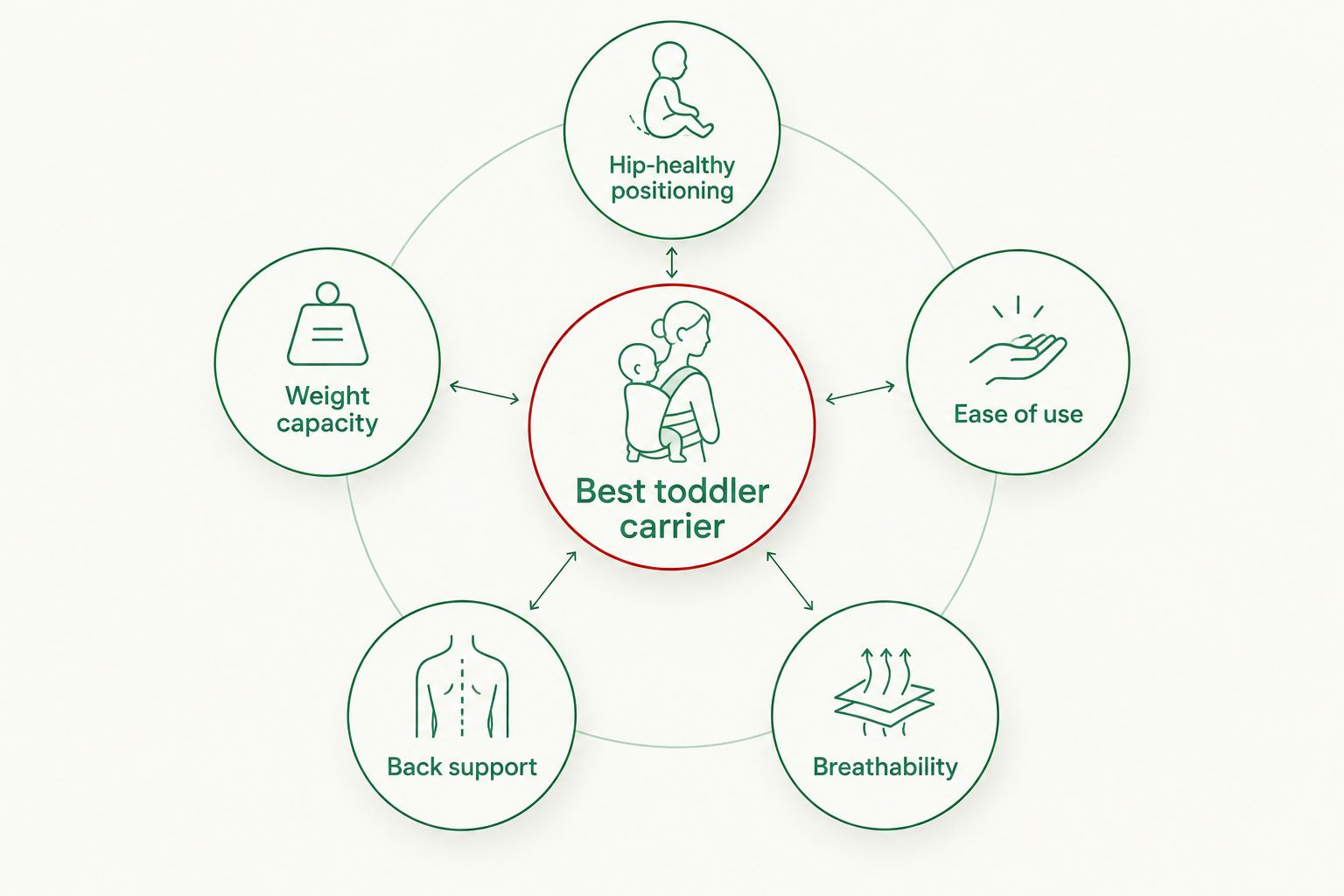
- Hip-healthy positioning — the seat should hold thighs in a spread-squat, M-shape position, not let legs dangle
- Weight capacity — check the carrier is rated for toddler weights, not just newborns (many go up to 20kg or beyond)
- Ease of use — can you get a wriggling, resistant toddler in and strapped up in under a minute
- Back support for the adult — padded, wide waist and shoulder straps matter more as toddlers get heavier
- Breathability — mesh or lighter fabric panels help through spring and summer 2026
Baby carriers for toddlers at a glance
Here's how the main toddler carrier types stack up before you commit to one for 2026.
| Carrier type | Best for | Standout feature | Key limitation |
|---|---|---|---|
| Soft structured carrier (SSC) | Everyday all-rounder | Wide adjustable hip seat and padded shoulder straps | Bulkier to pack in a changing bag |
| Framed backpack carrier | Long walks and hikes | Rigid frame spreads weight across the hips | Too heavy and bulky for quick errands |
| Hip seat carrier | Quick lifts and hip health | Rigid shelf supports weight without arm strain | Less back support over a full day |
| Ring sling | Fast in-and-out carries | Adjusts in seconds with no buckles | Weight sits on one shoulder |
| Meh dai / half-buckle | Budget-friendly flexibility | Tie straps fit almost any body shape | Takes practice to tie securely |
That comparison covers the basics — the sections below break down each type's pros, cons and best-fit scenario.
“If your arms ache after ten minutes of carrying, the carrier doesn't fit — not the child.”
1. Soft structured carrier (SSC): best baby carrier for a toddler for everyday use
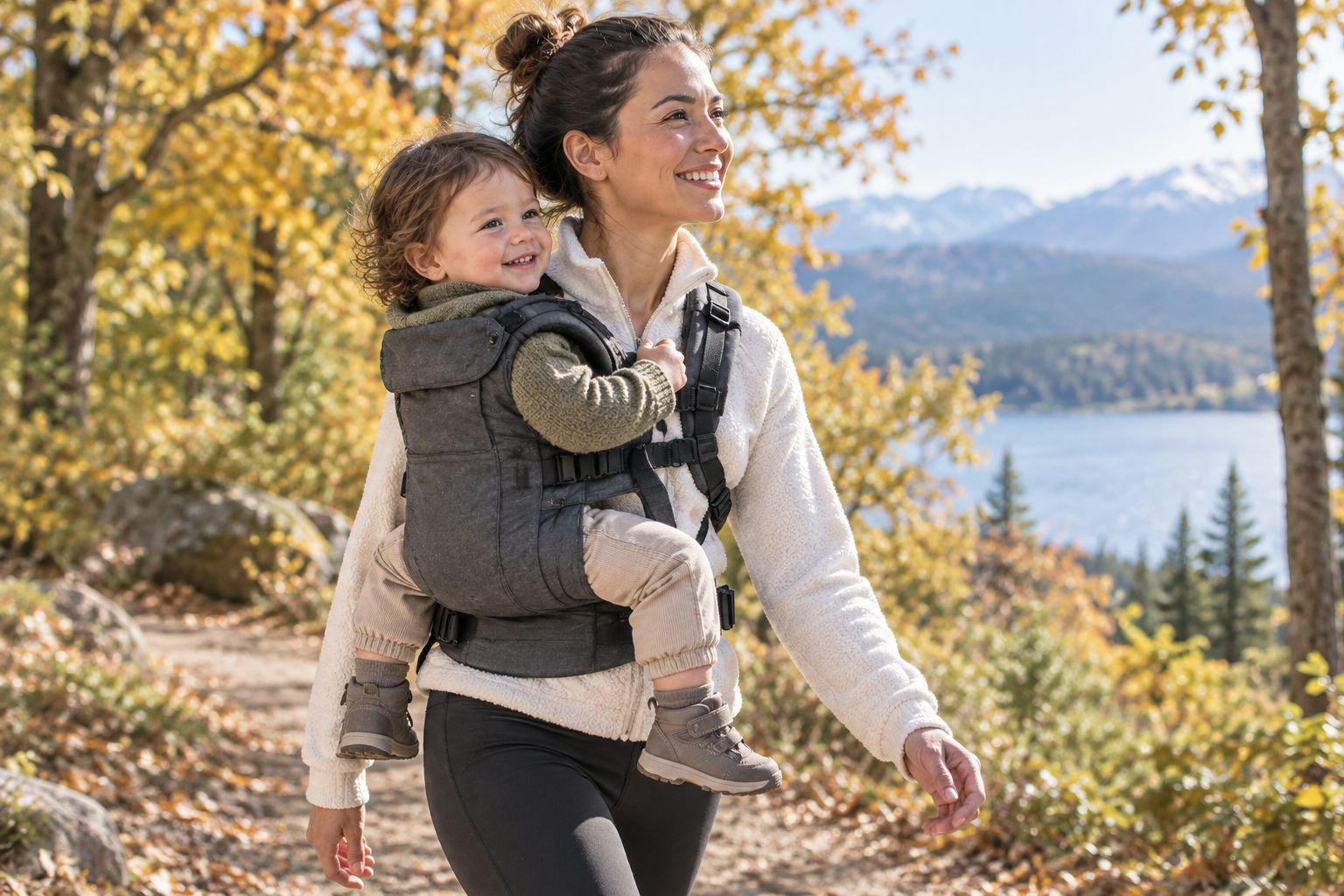
A soft structured carrier (SSC) uses buckles at the waist and shoulders, plus a padded, adjustable panel that widens to support a growing toddler's seat. It's the closest thing to a universal fit for parents who want one carrier from around 12 months through to the preschool years. Front, hip and back carry options come as standard on most SSCs.
Soft structured carrier pros:
- Buckles make it quick to put on without help
- Panel width adjusts as your toddler grows
- Padded straps spread weight across shoulders and waist, not just the arms
- Works for front, hip and back carrying positions
Soft structured carrier cons:
- Bulkier to pack in a changing bag than a sling
- A thick buckle carrier can feel warm on a hot day
- Slower to put on than a ring sling for a two-minute carry
Best for: parents who want one carrier that covers daily nursery runs, shopping trips and the odd long walk. Verdict: Buy.
2. Framed backpack-style toddler carrier: best for long walks and hikes
A framed backpack carrier uses a rigid internal frame, similar to a hiking rucksack, to transfer a toddler's weight onto the adult's hips rather than the shoulders. Most include a sun canopy and storage pockets for spare layers or snacks, which matters on longer spring and autumn walks in 2026.
Framed backpack carrier pros:
- Rigid frame handles heavier toddlers, often up to and beyond 20kg, with less shoulder strain
- Built-in storage means fewer separate bags on long days out
- Sun or rain canopy included on most models
Framed backpack carrier cons:
- Too bulky and heavy for quick errands or public transport
- Doesn't fold small enough for a nappy bag or car boot
- Overkill for a toddler who only needs carrying for ten minutes at a time
Best for: hiking, countryside walks and full days out where a toddler needs carrying for hours, not minutes. Verdict: Buy if you're regularly out for two hours or more; Skip if most of your carrying is short bursts.
3. Hip seat carrier: best for quick lifts and hip health
A hip seat carrier adds a rigid, shelf-like seat around the adult's waist, so a toddler's own body weight rests on a solid platform instead of the adult's arms or a soft panel. It's built for picking a toddler up for a few minutes at a time, not for hours of continuous wear.
Hip seat carrier pros:
- Rigid shelf takes the strain off the adult's arms almost immediately
- Fastest option for a toddler who wants up, then down, then up again
- Naturally supports the hip-healthy M-shaped seated position
Hip seat carrier cons:
- Less back support than an SSC over a full day
- Bulkier around the waist than a sling
- Some toddlers dislike the seat panel on longer carries
Best for: nursery pick-ups, supermarket trips and toddlers who want carrying in short, frequent bursts. Verdict: Buy for on-and-off use; Hold if you need all-day support.
4. Ring sling: best for quick, short carries
A ring sling is a single length of fabric threaded through two rings, tightened by hand and worn over one shoulder. There's no buckle to fasten and no panel to adjust, which makes it the fastest carrier to get a toddler into and out of.
Ring sling pros:
- Adjusts in seconds with no buckles or clips
- Folds small enough to fit in a coat pocket
- Good for a quick pick-up mid-tantrum or on tired legs during a walk
Ring sling cons:
- Weight sits on one shoulder rather than being spread evenly
- Not comfortable for toddlers over roughly 15kg for more than a short carry
- Takes a few tries to learn to tighten properly
Best for: short carries, a spare in the changing bag, or backup for tired legs on a walk. Verdict: Buy as a second carrier; Skip as your only one once your toddler is over 15kg.
5. Meh dai / half-buckle carrier: best budget option
A meh dai, sometimes called a half-buckle carrier, uses long fabric straps that tie around the body instead of a full buckle system, or a single waist buckle with tied shoulder straps. It's typically less structured than an SSC, which keeps the price down without losing the wide seat panel that supports hip health.
Meh dai pros:
- Simpler construction usually means a lower price than a fully buckled SSC
- Tie straps adjust to fit almost any body shape or layer of clothing
- Still supports the M-shaped seated position when tied correctly
Meh dai cons:
- Tying straps takes longer than clicking a buckle, especially with a wriggling toddler
- Less structured back panel than an SSC over a full day
- Harder to get a secure, even fit without some practice
Best for: parents who want the hip-healthy benefits of an SSC on a tighter budget and don't mind tying straps. Verdict: Buy if you're happy to practise the tie; Skip if you want something the whole family can grab and go without instruction.
How we ranked these
Every type above is judged against the same five points: hip-healthy positioning, weight capacity, ease of use, back support and breathability. None wins on all five — that's why the right pick depends on how often and how long you'll actually be carrying your toddler in 2026, not which carrier looks best in the box.
Which baby carrier should you choose for your toddler in 2026?
If you only buy one, make it a soft structured carrier with a wide, adjustable hip seat panel — it covers the most situations for a toddler between 1 and 4 years old and grows with your child longer than most other types.
Regularly out for hours at a time, hiking or on long countryside walks? A framed backpack carrier earns its bulk. Need something for the ten-minute walk to nursery or a supermarket queue? A hip seat carrier gets a toddler up and settled faster than anything else on this list.
Not every day out calls for carrying at all. When you'd rather push than wear, the guide to 3-in-1 travel systems covers the wheeled alternative for toddlers who still nap out and about in 2026.
FAQ
What's the best baby carrier for a toddler in 2026?
The best baby carrier for a toddler in 2026 is a soft structured carrier (SSC) with a wide, adjustable hip seat panel, since it covers front, hip and back carrying for children roughly 1 to 4 years old. Framed backpack carriers suit long hikes better, and hip seat carriers suit quick, short lifts.
Is a hip seat carrier better than a soft structured carrier for toddlers?
A hip seat carrier is better for short, frequent lifts, such as nursery pick-ups or a supermarket trip, because the rigid shelf gets a toddler up and settled in seconds. A soft structured carrier gives more back support over a full day, so it suits longer or more frequent carrying.
How long can you carry a toddler in a baby carrier?
Most parents manage comfortable carries of 30 minutes to a couple of hours in a well-fitted soft structured or framed carrier, depending on the adult's fitness and the toddler's weight. Shorter carriers like ring slings suit quick lifts of a few minutes at a time.
What weight can a toddler carrier hold?
Most toddler-specific carriers are rated to carry a child weighing roughly 9kg to 20kg or more, though the exact limit varies by model. Always check the stated weight rating before buying, especially on a secondhand carrier.
Can you use a newborn baby carrier for a toddler?
Not usually — carriers designed for newborns are rarely rated for toddler weights and lack the wider seat panel a growing toddler needs for hip support. A toddler-specific soft structured or framed backpack carrier is the safer choice past around 12 months.
Is babywearing bad for a toddler's hips?
Babywearing itself isn't the issue — the seated position is. The International Hip Dysplasia Institute recommends carriers that hold a toddler's thighs in a spread, M-shaped position rather than letting the legs hang straight down.
Front or back carry - which is better for a toddler?
Front carry suits younger toddlers and shorter carries because you can see their face and reactions. Back carry suits older, heavier toddlers on longer walks, since it keeps their weight closer to your centre of gravity and frees up your front for a bag or a second child.
Do I still need a carrier once my toddler can walk?
Yes, most parents still use a carrier well past walking age, since toddlers tire quickly on long walks, at busy events or on stairs. A hip seat or soft structured carrier covers those short, frequent lifts without needing a pushchair nearby.
One last thing
Check the stated weight rating before you reuse a carrier bought for the newborn stage — a panel built for a 4kg baby rarely supports a 12kg toddler safely, whatever the fabric looks like. If you're buying secondhand for 2026, the original product listing's weight limit is worth more than anything printed on a resale ad.
